
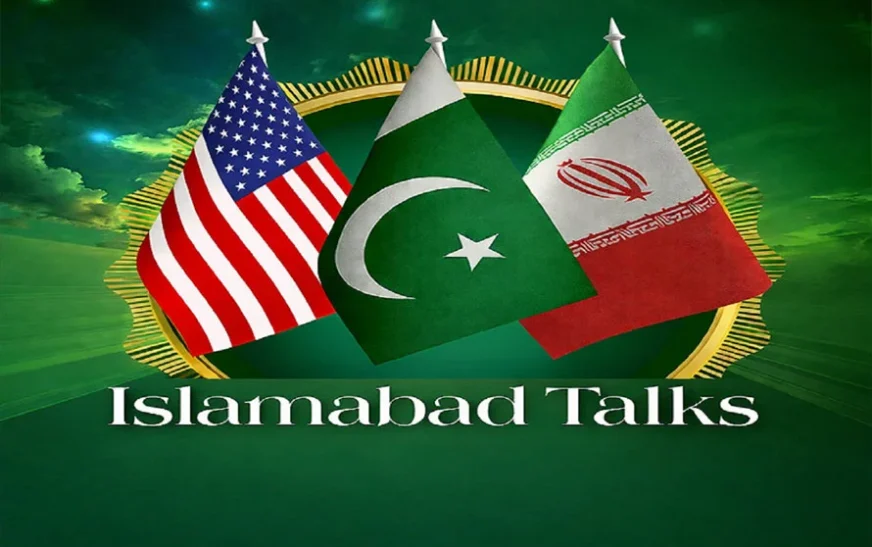
Fresh diplomatic efforts are underway as the United States and Iran prepare for another round of high-stakes talks before the current ceasefire expires, with Islamabad emerging again as a likely venue.
Another round of direct talks between the United States and Iran is expected before the two-week ceasefire announced on April 07 expires next week. According to multiple US media reports, both Tehran and Washington have agreed in principle to resume negotiations.
Sources familiar with the discussions say the goal is to hold these talks before April 21, with Islamabad being a strong contender to host once again. However, alternative venues like Geneva, Istanbul, Türkiye, and Egypt are also under consideration.
Reports from Bloomberg and the Associated Press confirm that Pakistan is likely to host the second round of talks soon. Prime Minister Shehbaz Sharif has also stated that efforts are ongoing to bridge the gap between the two sides.
The first round of marathon talks in Islamabad — lasting over 20 hours — ended without a breakthrough but kept diplomatic channels open. The meeting marked the highest-level engagement between the US and Iran in decades and the most significant since the 1979 Islamic Revolution.
US President Donald Trump has indicated willingness to continue negotiations, saying Iran had reached out and expressed eagerness to strike a deal. “We’ve been called this morning by the right people… and they want to work a deal,” Trump told reporters, without specifying details.
Republican leader Sajid Tarar revealed that discussions are underway in Washington about a possible visit by Trump to Pakistan. If confirmed, the US president could personally attend the final round of talks and help conclude what is being referred to as the “Islamabad agreement.”
US Vice President JD Vance led the initial talks in Islamabad but returned without securing an agreement. He stated that Iran failed to move far enough on key US demands. “They moved in our direction, but they didn’t move far enough,” Vance said, adding that a “grand deal” is still possible if Iran takes the next step. Iran, however, blamed the collapse on what it described as “excessive” US demands, while maintaining that differences cannot be resolved in a single round. A major sticking point remains Iran’s nuclear program, particularly uranium enrichment.
According to The New York Times, Iran has proposed suspending uranium enrichment for five years. However, the US is pushing for a much longer 20-year halt. This disagreement has emerged as a central obstacle in negotiations. The US has also demanded that Iran end all uranium enrichment, dismantle nuclear facilities, and hand over more than 400 kilograms of highly enriched uranium.
Iran, on the other hand, insists on recognition of its right to enrichment, lifting of sanctions, guarantees against future attacks, and continued control over the Strait of Hormuz. While diplomacy continues, the US has escalated pressure by initiating a naval blockade of Iranian ports and the strategically vital Strait of Hormuz.
The move has introduced uncertainty, with questions lingering over how far Washington is willing to go militarily and how Tehran might respond. Iran believes it holds leverage due to its control over the strait, a critical global energy route, while the US sees the blockade as a tactic to push Iran toward concessions. Details from the Islamabad negotiations reveal a tense and complex atmosphere. Delegations were housed in separate wings of the Serena Hotel, with Pakistani mediators shuttling between rooms.
At one point, talks appeared close to success — reportedly “80% there” — before collapsing over unresolved issues, including nuclear policy, sanctions, and Hormuz. There were moments of visible tension, with raised voices and walkouts. Pakistani officials, including military and diplomatic leadership, intervened to calm tensions and keep dialogue alive.
Despite setbacks, both sides developed a degree of mutual respect after prolonged engagement, with Trump noting his envoys found Iranian representatives “friendly and respectful.” Countries, including Türkiye, Egypt, and Oman, are actively involved in mediation efforts. A regional source indicated that Türkiye is working to bridge remaining gaps between Washington and Tehran. Pakistan continues to play a central role, passing messages between both sides even after the talks ended.
US officials say there is “forward motion” toward an agreement, and both sides may consider extending the ceasefire if negotiations show progress. There is also growing pressure domestically in the US to avoid further military escalation, while Iran faces economic strain and internal challenges following weeks of conflict.
The Islamabad Talks came after six weeks of war that killed thousands and disrupted global energy supplies. Central to the conflict is the longstanding dispute over Iran’s nuclear ambitions, which Tehran denies are aimed at building weapons.
Read also: Iranian Ambassador: Islamabad talks are a continuous process, not just an event