
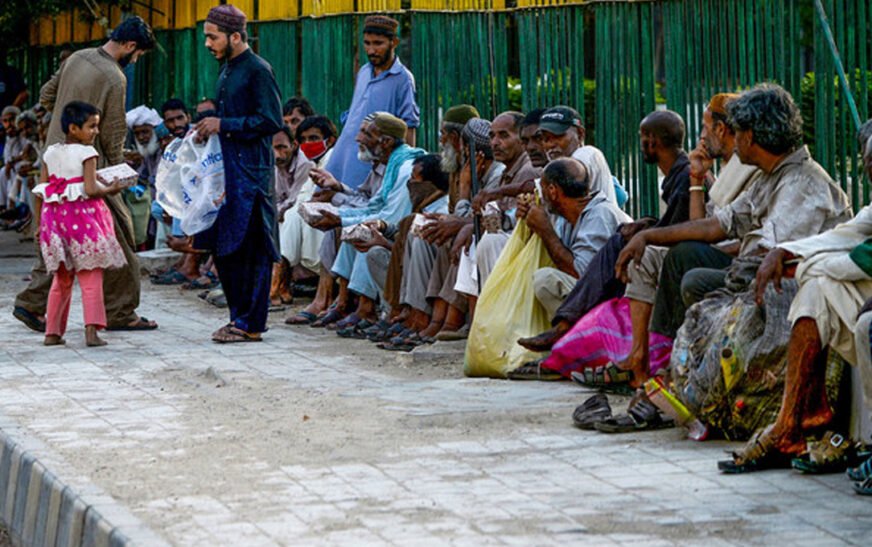
ISLAMABAD: Pakistan’s poverty rate has climbed to 28.9 percent, according to the Economic Survey 2025–26, highlighting growing economic pressure on households amid inflation and widening inequality.
According to the Economic Survey, almost 29 out of 100 citizens in Pakistan live below the poverty line based on the minimum consumption level determined by the country’s government. Furthermore, it is estimated that an individual making at least 8,483 rupees every month qualifies as being above the poverty line, which amounts to around 30.5 US dollars.
There are significant differences in the poverty rate across various provinces, with the highest level in Balochistan amounting to 47%. The second-highest poverty rate was found in Sindh Province at 32.6%. In Khyber Pakhtunkhwa, the poverty rate was observed to be at 35.3%, while Punjab had the lowest rate of 23.3%.
In addition, income inequality has risen to 32.7% from 28.4%. Inequality is also widespread across the various provinces, with the province of Sindh witnessing the largest income inequality at a rate of 35.9%, while Punjab ranks second with income inequality of 32% followed by Khyber Pakhtunkhwa and Balochistan with respective rates of 29.4% and 26.6%.
On the employment front, the labour force in Pakistan is reported at 83.1 million people out of which 77.2 million are employed. Nevertheless, 5.9 million people are still left unemployed.
It is also stated in the report that labour migration has been observed outside Pakistan, as in 2025, 762,499 Pakistanis moved abroad for employment.
According to economists, the overall increase in poverty, unemployment, and income inequality suggests continued economic pressures especially on the low and middle-class families of the country.
Finance Minister presents Pakistan Economic Survey, claiming 3.7 percent growth in GDP
Earlier, Federal Finance Minister Muhammad Aurangzeb presented the Pakistan Economic Survey of the financial year 2025-2026, claiming growth of 3.7 percent in Gross Domestic Product (GDP) in the ongoing fiscal year.
Addressing a press conference in Islamabad, Finance Minister Muhammad Aurangzeb presented the survey, which he said told a story of resilience and discipline shown during the previous year. He said that this growth is higher than last year’s growth of 3.18pc but falls short of its target of 4.2pc.
He said the country began the outgoing fiscal year with uncertainty due to tariffs. “Then, by the end of July, we reached a point where we could be in a competitive position with respect to our exports, especially to the US,” he added.
Then there were floods in August and September 2025, followed by a regional conflict in March this year. “These challenges tested Pakistan’s resilience,” he said, adding that the government was able to deal with them and remained on the path of moving from stabilisation to growth.
He said GDP growth in FY26 was recorded at 3.7 per cent, against a target of 4.2 percent. However, the economic survey stated that the economy improved its growth momentum in FY2026, compared to the previous year, when GDP growth was recorded at 3.18pc.
“The improvement owes to effective macroeconomic management, better fiscal account, growth in the large-scale manufacturing (LSM) sector, resilience of the agriculture sector to floods of 2025, exchange rate stability, and reforms under the IMF Extended Fund Facility (EFF) Programme,” it stated.
For his part, Aurangzeb also pointed out that global growth had reduced to 3.1pc from 3.7pc due to the factors he elaborated on earlier in the press conference. The finance minister said that Pakistan had recorded GDP growth of 3.7pc, which was the highest in the past four years. The finance minister recalled that GDP growth in FY2023 was -0.2pc, 2.6pc in FY2024, and 3.2pc in FY2025.
He said it was earlier estimated that GDP growth would exceed 4pc, but it did not happen due to the ongoing conflict in the Middle East. “We have still reached a historically high size of the economy at Rs126.9 trillion,” he said. The minister said GDP per capita income had reached $1,901, which was $1,751.
Giving a sector-wise breakdown, he said growth in agriculture was recorded at 2.89pc, compared to 1.53pc in the last fiscal year. “This was despite floods,” he said, adding that the crop sub-sector showed positive growth. After contraction, it was recorded at 1.44pc, the finance minister said.
He added the livestock sector also “continues to go from strength to strength”. Aurangzeb said 6.1pc growth was recorded in large-scale manufacturing (LSM) in FY26, which was the highest in the last four years. He elaborated that positive growth was seen in 16 of LSM’s 22 sub-sectors.
“So it’s not one single sector that is leading or contributing to this 6.1pc turnaround in LSM. It is broadband growth,” he said. He further said that prominent year-on-year growth was witnessed in this sector. “To give you some examples, there was a 10pc increase in the demand for cement, 17pc for fertiliser, 5pc for petroleum, 31pc for automobiles and 9pc for mobile phones.”
Noting that the services sector made up close to 58 percent of Pakistan’s GDP, he said 4.9 percent growth was recorded in this sector in the outgoing fiscal year.
He particularly mentioned communication and information services, which he said recorded a growth of 7.52pc. The growth in this sub-sector in FY26 was also the highest over the past four years.