

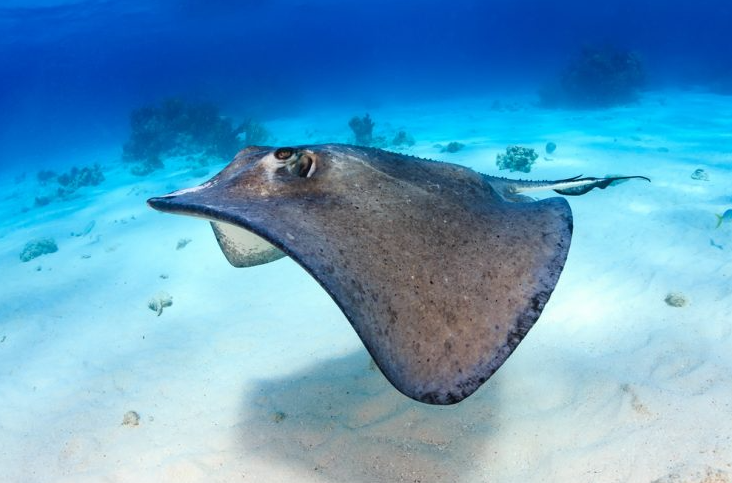
KARACHI: Strange fish with bat-like bodies and leopard-like spots on their skin have been spotted along the coasts of Karachi and Balochistan in recent days.
Videos of these several-feet-long fish have gone viral on social media, with many people mistaking them for a new or rare species. However, according to experts, this is not a new discovery. It is a type of stingray that has been present in Pakistan’s coastal waters for decades. Stingrays are considered relatives of sharks and play an important role in the marine ecosystem. In Pakistan, they are mainly caught in coastal and open sea areas using nets.
Which species are these?
Mohammad Moazzam Khan, Technical Advisor at WWF-Pakistan and a marine life expert, told Urdu News:
“There are about 38 species of stingrays found in Pakistan, in both coastal areas and deeper parts of the sea.”In recent days, these large stingrays with leopard-like markings have been seen at Clifton Beach in Karachi and Kalmat Beach in Balochistan, among other places.
At Clifton, local fishermen caught them using a beach seine net, which is commonly used in coastal areas with strong waves. Locally, these fish are called ‘Garabari Pittan’ or ‘Cheeto’. In the Balochi language they are called ‘Garabari’.
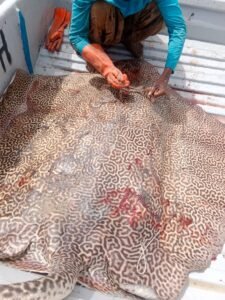
“In Kalmat, an entire boat was filled with just one of these fish. You rarely see stingrays of this size,” Khan said.
According to him, these fish have been regularly found along the coasts of Balochistan and Sindh for the past 50-60 years.
“Why are they being caught more now?
Experts say the main reason is their growing commercial value.”These large fish are very attractive because of their color patterns and size. Fishermen collect them and sell them to processing plants for export,” Khan explained.
For the last 60-70 years, stingrays in Pakistan were mostly used for fish meal for the poultry industry because they have a bad taste and are not eaten locally.
But in the last 10 years, the situation has changed. Now their ‘wings’ are frozen and exported in large quantities to Thailand, Indonesia, Malaysia and other countries.
According to experts, Pakistan’s annual stingray production is about 10,000 metric tons. Due to rising foreign demand, prices have increased significantly, prompting fishermen to now target them specifically.
Khan said that three types with leopard-like spots were found at Clifton: Leoparda, Reticulate, and Aernak. The Aernak species was seen in the largest numbers. All three types are also exported. Experts warn that these fish take many years to reach such a large size.
“If we are not careful, their stocks could come under severe pressure,” Khan said. WWF-Pakistan has been researching stingrays for the last 12 years. In a statement, WWF said its observations show that their numbers are continuously declining.
WWF urged that catch limits should be set for stingrays, warning that if hunting continues unchecked, Pakistan’s stocks could be depleted. Khan added that stingrays are related to sharks and give birth to very few pups — only 1 or 2 at a time. This makes it even more important to manage their fishing properly.”We should conduct the hunting and export of this fish in a thoughtful and balanced manner, and completely stop using it for fish meal so that we can preserve this beautiful marine creature for future generations,”
Experts say that under normal conditions these fish are harmless to humans. However, danger can arise if someone accidentally steps on one.
They have a sharp spine on their tail that can pierce a leg and cause severe pain. Care must be taken when removing it, otherwise the wound can become deep.
Read also: Dandy Dirdoni Dam- A popular spot for fish farming and fry fish food