

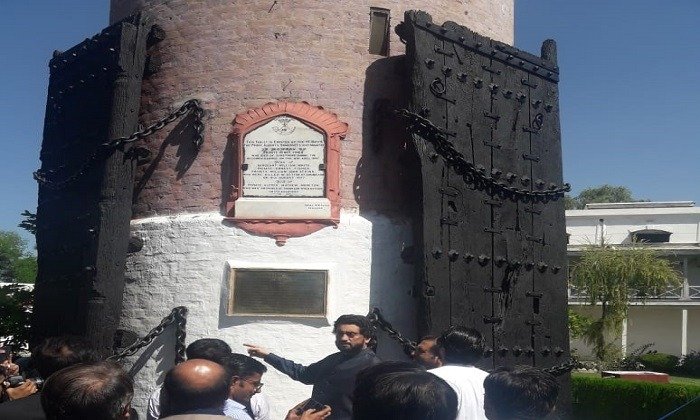
SHABQADAR: Nestled on the edge of the Peshawar Valley, where the plains of Charsadda meet the hills of Mohmand, stands a fort that has been chained for 185 years. Its massive wooden gates have not opened freely since 1840, not because they are broken, but because they were put on trial and sentenced.
This is Shabqadar Fort, and if its walls could speak, they would tell you the story of three empires, countless tribal uprisings, and the last echoes of the mighty Durranis.
Long before the fort was built, the land around Shabqadar breathed under the flag of the Durranis. In 1747, Ahmad Shah Durrani rose in Kandahar and carved out an empire that stretched from Mashhad to Delhi. Peshawar became his winter capital, and the entire valley, including the quiet agricultural settlements that would one day be called Shabqadar, fell within the Durrani realm.
But Durrani rule here was never like rule in Kabul or Herat. This was Pashtun country. The Mohmand tribes paid allegiance when it suited them and governed themselves through jirgas the rest of the time. The Durrani governors in Peshawar collected taxes and demanded loyalty, but the hills around Shabqadar remained fiercely independent.
For nearly 80 years the area lived this way, Muslim, tribal, and loosely tied to an empire that was already beginning to fracture after Ahmad Shah’s death. That fracture opened the door for new masters. By the 1830s the Sikh Empire under Maharaja Ranjit Singh had pushed west and taken Peshawar in 1834. The Sikhs understood one thing the Durranis had struggled with: if you wanted to hold this frontier, you needed stone, guns, and fear.
In 1837, Sikh architect Tota Ram was ordered to build a fort at Shabqadar, about 30 kilometers from Peshawar. It was not a palace. It was mud, stone, and timber designed to watch the Mohmand passes and remind the tribes who was in charge now. European generals who had come to Ranjit Singh’s army after Waterloo, men like Jean-Baptiste Ventura and Paolo Avitabile, trained the Sikh troops stationed here. For a brief time Shabqadar became a Sikh outpost deep in Pashtun land.
That experiment did not last. In 1840, one night, Mohmand lashkars came down from the hills and smashed the fort’s gates. Sikh soldiers were killed and the tribes withdrew. The breach humiliated the Sikh command. Prince Sher Singh, son of Ranjit Singh, ordered an inquiry. The verdict was strange and telling of how the Sikhs saw honour.
The gates themselves were court-martialed for dereliction of duty and sentenced to 100 years in chains. They were shackled in 1840 and never taken off, even after the sentence expired in 1940. Today visitors still walk through those imprisoned gates, a living punishment from a dead empire.
The Sikhs themselves did not last much longer. In 1849 the British defeated them and took the Punjab and the Frontier. Shabqadar passed to the British Raj and found a new purpose. Now it was a base for campaigns into tribal territory. The fort saw another major attack in August 1897 during the Frontier Revolt, when the Hadda Mullah called for jihad and Mohmand tribes stormed the British-held walls.
They were beaten back, and the Mohmand Field Force was sent in retaliation. It was during this time that a young war correspondent named Winston Churchill spent nights in a small room in the fort, writing about the tribal uprising. That room, with his bed, old chairs, and black and white photos, is still there.
When Pakistan was born in 1947, Shabqadar did not change hands through war but through a line drawn on a map. The fort became part of the new country and was handed to the Frontier Constabulary. Roughly 1800 personnel still train there today, walking past the same chained gates and Sikh-era walls.
So what does Shabqadar remember?
It remembers the Durranis, the last great Muslim empire to claim this valley, even if their grip was loose and tribal. It remembers the Sikhs, who came with European tactics and built a fort that outlived their empire by nearly two centuries. It remembers the British, who turned it into a launchpad for frontier wars and left behind Churchill’s room.
The Mohmand tribes are still there. The chains are still on the gates. Empires come and go, but in Shabqadar the stones stay, and they keep score.
Read also: Three Killed in Suspected Honour Killing in Charsadda’s Matta Mughal Khel







1 Comment
[…] Shabqadar Fort: The Fort That Remembers Empires […]