
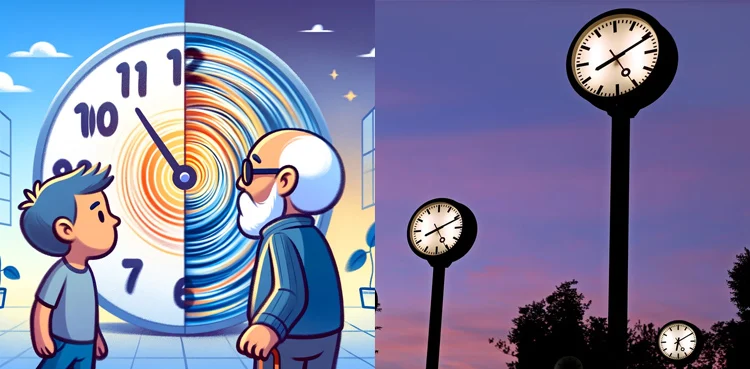
People often feel that childhood days lasted longer while the years of adulthood and old age seem to pass quickly. Researchers say the clock does not actually speed up; rather, the way humans perceive the passage of time can change with age.
A 2019 study published by Cambridge University Press examined the difference between clock time and the time experienced psychologically, highlighting several possible explanations for why time may appear to move faster as people grow older.
According to researchers, clock time passes at a constant rate, but the human brain can perceive it differently depending on experiences, memories and mental states.
One possible explanation is the proportional theory. For example, at the age of 10, one year represents around 10 per cent of a child’s life so far, while at 50, a year accounts for only about 2pc of a person’s accumulated life experience.
Under this theory, each new year may feel proportionally shorter as a person grows older.
Another possible factor is a decline in novel experiences. During childhood, people are frequently exposed to new activities, places, people and experiences, giving the brain a large number of distinctive memories to store.
As people grow older, however, routines and repetitive activities can become more common. When days, weeks and months follow similar patterns, it may become harder to distinguish one period from another in memory. Looking back, this can make long periods of the past seem to have passed quickly.
Attention may also influence the perception of time. During familiar tasks, the brain can perform several activities automatically, while attention remains focused on the task rather than on the passage of time.
Emotional experiences may also affect how time is remembered. Moments associated with fear, happiness, excitement, surprise or other strong emotions tend to leave more distinctive memories.
By contrast, periods dominated by stress, fatigue, boredom or repetitive routines may blend together in memory, making the elapsed time appear shorter.
Another possible factor is dopamine, a chemical messenger in the brain associated with motivation, reward and other brain functions. Changes in dopamine levels and brain processes with age may also influence the perception of time.
Researchers stress that these are possible explanations for the subjective experience of time rather than evidence that time itself changes speed.
Although people cannot actually slow down the passage of time, researchers suggest that engaging in new experiences and activities may make periods of life more memorable.
Adrian Bejan, a professor of mechanical engineering and author of the research, has suggested that trying unfamiliar activities, seeking surprising experiences, exploring new ideas and engaging in creative pursuits can contribute to a richer perception of time.
The feeling that time accelerates with age may therefore be linked to the complex ways in which the brain processes memories, attention, emotions and experiences.
Read also: Kohat Tragedy: Health Department Reports 21 Killed Including Police Personnel, 103 Injured