
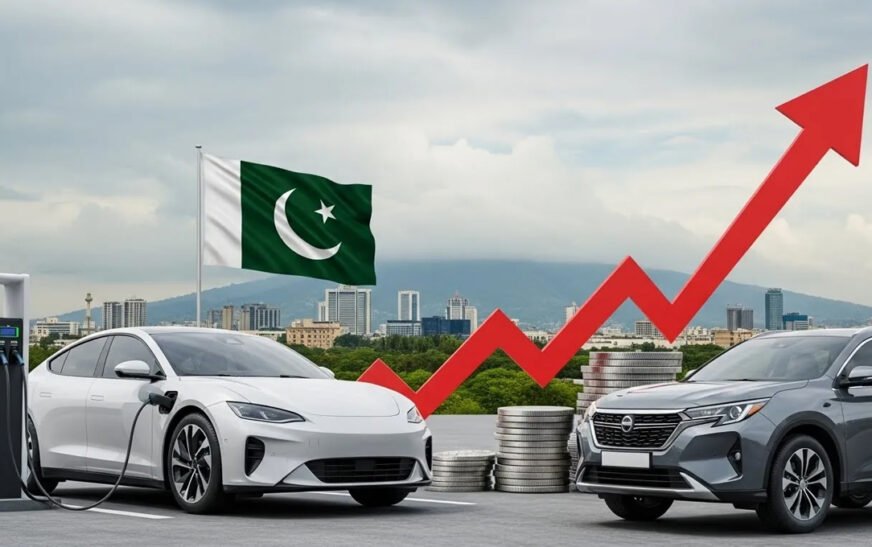
ISLAMABAD: The government has announced a series of measures targeting the automobile sector in the upcoming fiscal year, including the imposition of Federal Excise Duty (FED) on luxury imported electric vehicles, while continuing incentives for environmentally friendly transport.
Finance Minister Muhammad Aurangzeb said the government will maintain tax incentives for electric motorcycles, rickshaws, cars, and buses as part of its broader strategy to promote clean energy and reduce fuel imports. He added that the policy aims to support the expansion of electric mobility while addressing environmental concerns.
At the same time, the minister proposed a one percent sales tax on imported electric trucks to encourage the adoption of electric technology in the transport and logistics sector. However, he clarified that Federal Excise Duty will be imposed on high-end imported electric vehicles priced above Rs20 million.
He further stated that FED will also apply to imported vehicles with engine capacities above 2000cc and 3000cc, in line with the government’s focus on discouraging luxury imports.
Aurangzeb emphasized that the government’s priority is to support the general public and domestic industry rather than luxury consumption. He said efforts would continue to ensure sustainable growth of the auto sector, promote local manufacturing, and expand eco-friendly transport options across the country.
Big Relief for Salaried Class as Government Cuts Income Tax Rates
Meanwhile, the government has unveiled significant tax relief measures for the salaried class as part of the new Budget 2026-27, aiming to ease the financial burden on middle- and upper-middle-income earners.
As per the latest announcement by the government, individuals having an annual income of between Rs2.2 million to Rs3.2 million would be taxed at 20% instead of 23%, while the income group of Rs3.2 million to Rs4.1 million would only be subject to 25% tax against the earlier 30%.
Similarly, people having annual incomes of Rs4.1 million to Rs5.6 million will pay 29% tax compared to 35%, while income earners from Rs5.6 million to Rs7 million would pay 32% against 35%.
The government has, however, decided to do away with the surcharge that was imposed on the salaried individuals previously.
According to ministry officials in the Finance Division, the new measure has been taken to improve the disposable incomes of salaried individuals, boost consumption, and spur economic growth.
Tax experts say the decision is a “big relief” for middle- and upper-middle-class Pakistanis, who have been bearing a heavy burden because of increased costs of living.
The new tax rates are expected to take effect immediately with the start of the new fiscal year, ensuring that salaried individuals benefit without delay.
The relief package also includes significant reductions for different monthly income levels. Individuals earning up to Rs50,000 per month are now fully exempt from income tax. Salaried individuals earning Rs100,000 per month will pay Rs500 in tax, down from Rs2,500.
Those earning Rs150,000 per month will face Rs6,000 instead of Rs10,000 in taxes, while a monthly income of Rs200,000 will now be taxed at Rs13,500 compared to Rs19,167 previously. Higher earners will also benefit, with Rs225,000 monthly income now taxed at Rs19,250, Rs250,000 at Rs25,000, Rs300,000 at Rs38,833, and Rs350,000 at Rs54,250. For top-tier salaries, Rs500,000 will be taxed at Rs106,750, Rs800,000 at Rs211,000, and Rs1 million at Rs307,000, down from Rs317,000.
Officials emphasized that the new tax rates take effect immediately with the start of the new fiscal year, ensuring that salaried individuals benefit without delay. The government said these measures will not only ease financial pressure on citizens but also reinforce a growth-friendly and equitable tax system.