

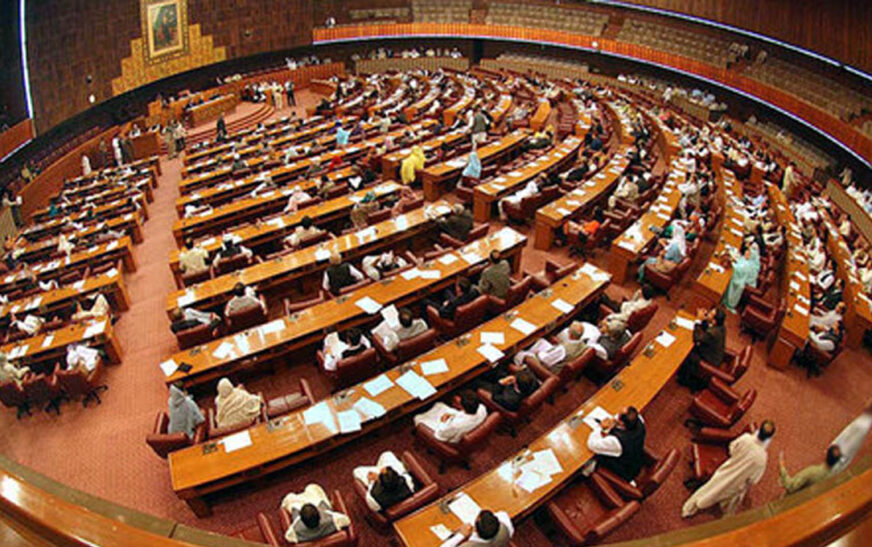
ISLAMABAD: The National Assembly has approved a resolution ratifying the imposition of emergency in Khyber Pakhtunkhwa (KP), following a heated debate between government and opposition lawmakers over the province’s security situation, rising terrorism and constitutional implications.
The resolution, presented by Federal Minister for Parliamentary Affairs Tariq Fazal Chaudhry, was passed by a majority vote. Opposition members opposed the move, raising concerns about its political and constitutional consequences.
The session was chaired by National Assembly Speaker Sardar Ayaz Sadiq, while Attorney General Mansoor Usman Awan was also present during the proceedings.
Government Cites Rising Terrorism and Security Threats
Speaking during the debate, Federal Law Minister Azam Nazeer Tarar said the emergency had been imposed after careful consideration of the deteriorating security situation in the province.
He cited internal unrest, cross-border infiltration and actions by the provincial government as factors that, according to him, had increasingly threatened national security.
Tarar said the Constitution required the presidential emergency proclamation to be presented before Parliament for approval within the stipulated period. He maintained that the federal government had made efforts to resolve the situation through negotiations before proceeding with the measure.
The law minister also referred to an increase in terrorist incidents, claiming that 3,787 terrorism-related incidents had occurred in 2026. He argued that the worsening security situation required a strong response and criticised the provincial leadership for what he described as a failure to adequately address the challenge.
Tarar further said negotiations between the government and opposition had continued for two days but failed to produce a lasting agreement on counterterrorism and other political issues.
Opposition Questions Constitutionality of Emergency
Opposition Leader Mahmood Khan Achakzai criticised the government’s decision, arguing that the move raised serious questions about provincial autonomy, democratic governance and the federal structure.
He accused successive governments of contributing to Pakistan’s security challenges and called for political dialogue to address the crisis. Achakzai also raised concerns about security operations, governance in the tribal districts and restrictions on political engagement.
Pakistan Tehreek-e-Insaf (PTI) Chairman Barrister Gohar Ali Khan also rejected the government’s position, accusing it of undermining democracy and using terrorism as a justification for political action.
Gohar maintained that his party supported efforts to combat terrorism but argued that security matters should be addressed through the relevant forums, including provincial authorities and the appropriate security committees.
He also raised concerns about the treatment of PTI founder Imran Khan and called for the implementation of court decisions.
Bilawal Bhutto Calls for Renewed Dialogue
Pakistan Peoples Party (PPP) Chairman Bilawal Bhutto Zardari said the opposition had the right to disagree with the emergency decision but stressed that counterterrorism required a coordinated national response.
Bilawal said President Asif Ali Zardari had attempted to pursue negotiations before approving the emergency measure. He maintained that the government had made efforts to find an alternative and avoid imposing emergency rule.
While supporting the federal government’s decision, Bilawal urged both the government and opposition to resume talks and find common ground.
He described the emergency as a measure taken under difficult circumstances rather than a permanent arrangement, emphasising that political differences should not prevent cooperation against terrorism.
Bilawal also called on the provincial leadership and opposition parties to play a constructive role in restoring security, adding that a united response was necessary to confront the threat.
Defence Minister Highlights Past Security Policies
Defence Minister Khawaja Asif defended the emergency, arguing that the prevailing circumstances had left the government with limited options.
He criticised past decisions concerning the return and resettlement of militants, referring to discussions involving former military leadership and the previous government’s security policies.
Asif said terrorism was a challenge that required collective action and accused the provincial leadership of prioritising political considerations over security concerns.
He stressed that the government, opposition and provincial authorities would need to work together to address the ongoing threat.









1 Comment
[…] ALSO READ: From Political Turmoil to Peace: National Assembly Approves Emergency in KP […]