
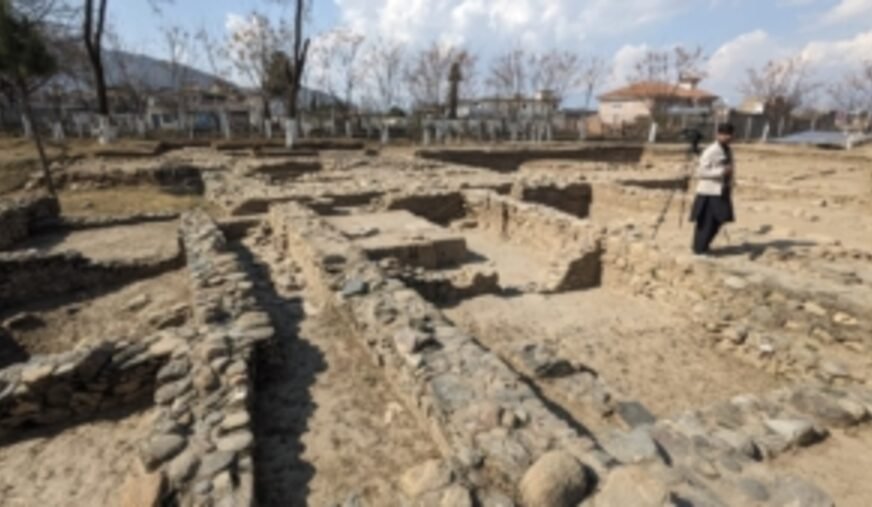
Butkara, an ancient Buddhist archaeological site in Swat’s main city Mingora, holds significant historical importance due to the extensive remains discovered there from the Buddhist period.
The site was first formally excavated in 1956 by renowned Italian archaeologist Dr Giuseppe Tucci, who uncovered a large number of ancient objects, artefacts and coins.
The remains at Butkara include Buddhist religious structures spread over an area of around 1,800 square metres, indicating that the site once served as a major place of worship. Remains believed to be associated with royal palaces have also been discovered in the area.
One of the most significant discoveries is a large stupa surrounded by around 250 smaller stupas. Archaeologists believe the site may have served as an important centre of Buddhist religious and cultural influence.
Around 7,000 sculptures carved from green stone were also recovered from the site. The sculptures are believed to have been installed around the main stupa. Golden reliquaries discovered inside some of the smaller stupas further highlight the religious and historical significance of Butkara.
Some of the archaeological remains found at the site have been dated from the second century BC to the 11th century AD. According to Dr Tucci’s research, the Swat region remained an important centre of Buddhism for nearly 300 years during the religion’s period of prominence.