
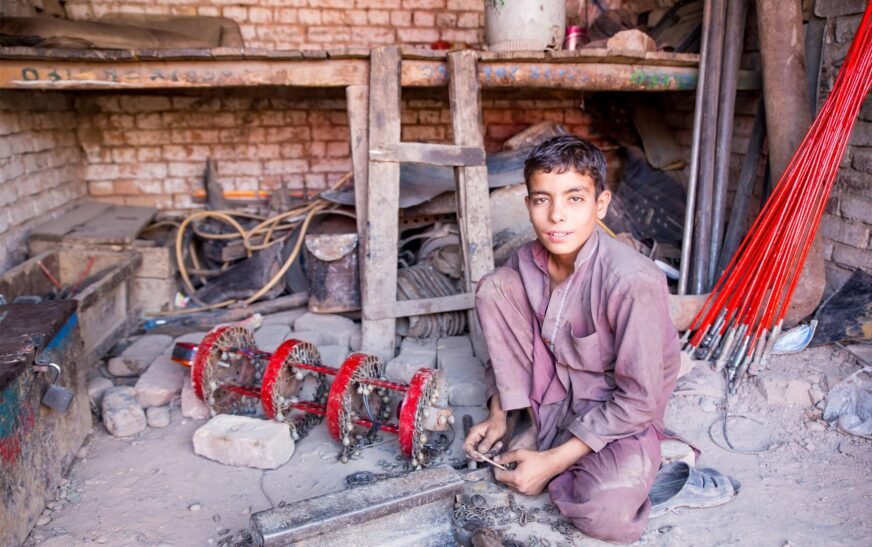
ISLAMABAD: A major national report jointly prepared by the National Commission for Human Rights (NCHR) and UNICEF has revealed that approximately 8.6 million children in Pakistan are engaged in child labour, with more than 6.6 million involved in hazardous work that poses serious risks to their health, safety, and future.
Titled Pakistan Child Labour Surveys, Evidence for Action, the report provides the first nationally representative dataset on child labour in nearly three decades. It offers a comprehensive assessment of the scale, prevalence, sectors, risks, and root causes of child labour across the country.
According to the findings, Punjab bears the largest burden, with around six million children engaged in labour. Sindh follows with 1.6 million child labourers, while Khyber Pakhtunkhwa has approximately 745,155 affected children and Balochistan 201,352.
In Islamabad Capital Territory, 15,180 children were recorded as being involved in labour activities.
The report identifies poverty as the leading driver of child labour, with the highest prevalence found among children from low-income households and families with limited educational attainment.
According to the report boys were found to be significantly more likely than girls to be engaged in labour, particularly in hazardous occupations.
Researchers noted that a large proportion of child labour occurs within family settings, including agricultural work, family-run workshops, and household-based activities.
As a result, much of this labour remains outside the scope of traditional labour inspection and monitoring systems.
The report also highlights the severe impact of child labour on children’s well-being. Many working children are deprived of education, endure long working hours, and face increased risks of injuries, illness, exhaustion, and mental health challenges.
Between 32 and 58 percent of working children across various provinces reported suffering injuries or illnesses related to their work, while up to one-third of older working children exhibited symptoms associated with depression.
Speaking at the report’s launch, NCHR Chairperson Rabia Javeri Agha said Pakistan’s last comprehensive child labour survey was conducted in 1996, forcing policymakers and development partners to rely on outdated or incomplete data for more than two decades.
Federal Minister for Human Rights Senator Azam Nazeer Tarar said child labour is more widespread than previously estimated and called for stronger laws, greater resources, and coordinated national efforts to address the issue.
Read also: Over 25 million children are out of school, education ministry