
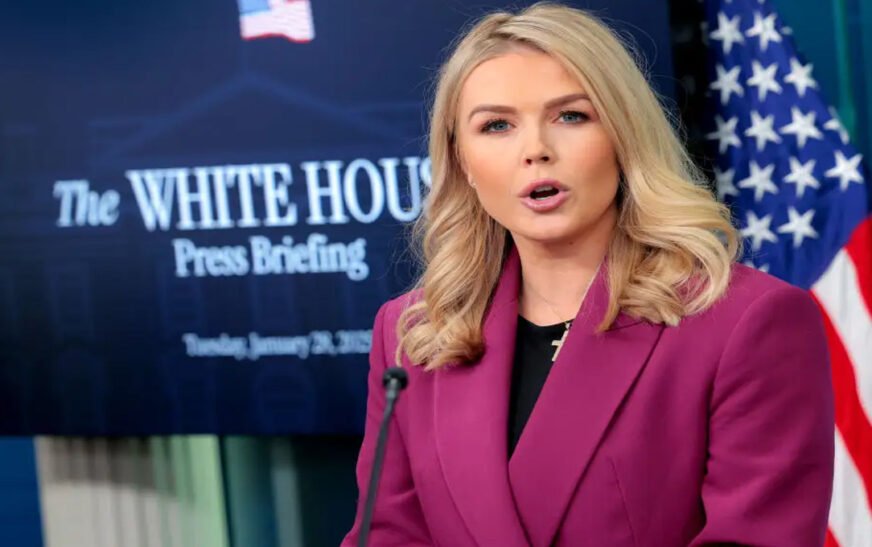
WASHINGTON: White House Spokesperson Karoline Leavitt has denied any allegations concerning a possible deadline that President Trump had given for reaching a ceasefire deal with the US’s adversaries.
According to Leavitt, the reports were untrue, and President Trump had not set a particular period within which he expected a ceasefire deal with Iran. In her address, she added that the President’s decision on the timing would be left at the discretion of the Commander-in-Chief. According to her, the President had only given Iran some time within which they had to agree to reach some sort of agreement while maintaining a temporary ceasefire.
The US government was now waiting for a response from Iran on the same, since it expects them to give a unified response to continue with the ceasefire. With regards to the military operation, Karoline pointed out that the current situation in the Strait of Hormuz is satisfactory for President Trump since the economic pressure forced them to the negotiating table.
US forces refute media claims, reinforce blockade against Iran
Earlier, US military forces have directed 29 vessels to turn around or return to port as part of the ongoing blockade against Iran, as tensions in the region continue to escalate.
In the past 24 hours, media outlets have circulated claims that several commercial ships had successfully evaded the blockade, citing vessels such as M/V Hero II, M/V Hedy, and M/V Dorena as examples. However, the US military swiftly refuted these reports.
In a statement issued by US Central Command (CENTCOM), officials clarified that the claims were inaccurate. Contrary to what was reported, M/V Hero II and M/V Hedy, both Iranian-flagged tankers, did not break through the blockade as part of a flotilla transporting oil to global markets. These vessels had been intercepted by US forces earlier this week and are currently anchored in Chah Bahar, Iran.
U.S. forces have directed 29 vessels to turn around or return to port as part of the U.S. blockade against Iran.
Over past 24 hours, media reports have alleged that several commercial ships evaded the blockade, citing M/V Hero II, M/V Hedy, and M/V Dorena as examples. These… pic.twitter.com/SKelkSOr77
— U.S. Central Command (@CENTCOM) April 22, 2026
Furthermore, the M/V Dorena has been under the escort of a US Navy destroyer in the Indian Ocean after it attempted to violate the blockade in a previous incident. CENTCOM emphasized that these vessels had not evaded enforcement actions, as suggested by the media.
The US military reiterated its global operational reach, confirming that US forces are actively enforcing the blockade not only across the Middle East but also in regions beyond. The blockade is part of broader efforts to curb Iran’s oil exports, which the US government has long linked to funding Iran’s destabilizing activities in the region.
While media reports had suggested that several vessels were bypassing sanctions, US officials made it clear that such claims were false and underscored the effectiveness of the US military’s operations in the region. The blockade has been a critical component of the US strategy to apply economic pressure on Iran as part of a broader effort to limit Tehran’s access to international markets and mitigate its nuclear and regional ambitions.
The US Navy’s ongoing operations are expected to continue as the situation develops, with further updates anticipated as the military maintains its focus on maritime security in the region.