

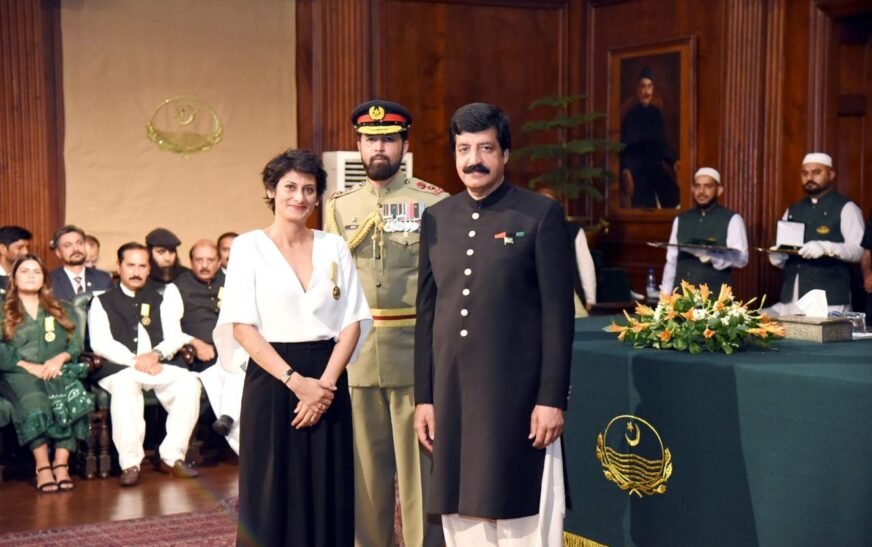
ISLAMABAD: Justice Project Pakistan (JPP) has been awarded the prestigious Tamgha-e-Imtiaz in recognition of its outstanding contributions to the promotion and protection of human rights in Pakistan. The honour acknowledges JPP’s continued efforts in legal advocacy, justice reform, and support for vulnerable communities across the country.
For nearly two decades, Justice Project Pakistan (JPP) has worked alongside those most vulnerable within Pakistan’s justice system, individuals facing execution, torture, and indefinite imprisonment, as well as Pakistanis held beyond the reach of the law, often with little public sympathy and even less protection.
Seventeen years ago, Belal read a letter from a man on death row asking for someone to intervene before it was too late. She picked up the phone. That call became the starting point for an organisation that would go on to take on some of the most difficult and unpopular cases in the country, often against the weight of public opinion, and within systems resistant to change.
Founded in 2009, JPP represents prisoners facing the harshest punishments, including those on death row, persons with severe mental illness, survivors of custodial torture, and Pakistanis detained beyond the reach of the law. Its work brings together strategic litigation, investigation, public advocacy, and storytelling to challenge how punishment is understood and applied.
It is in this context that the Tamgha-e-Imtiaz 2026 for Excellence in Human Rights (Law) has been conferred upon JPP’s Executive Director, Sarah Belal.
Over the years, this work has contributed to a quiet but meaningful shift. Pakistan has not carried out an execution since December 2019. Legal safeguards have expanded, including a landmark Supreme Court judgment prohibiting the execution of persons with severe mental illness and the passage of Pakistan’s first law criminalising custodial torture.
Beyond Pakistan’s borders, JPP’s litigation on behalf of Pakistanis held without charge in Bagram established that due process must follow citizens wherever they are detained, contributing to the return of hundreds of Pakistanis held abroad.
Alongside its legal work, JPP has used art and storytelling to bring public attention to lives often kept out of view, and shifted how justice and punishment are understood.
This work has often meant standing in difficult spaces: defending those few are willing to stand with, and insisting on the humanity of individuals the system has already written off.
“This medal belongs to the people who trusted us when the system had abandoned them,” said Sarah Belal. “To those who wrote to us from death row and from prisons far from home, often believing no one would come. To the families who refused to give up. And to the JPP team that continues to show up for them, day after day..”
Pakistan’s criminal justice system continues to face deep structural challenges, including custodial torture, wrongful convictions, and one of the largest known death row populations in the world. For many, access to justice remains out of reach.
As the country continues to grapple with questions of justice, fairness, and human dignity, JPP remains focused on the same principle that has guided its work from the beginning: that the law must protect those most at risk, not just in principle, but in practice.













1 Comment
[…] Read also: Tamgha-i-Imtiaz conferred on JPP for contributions to human rights […]