

ISLAMABAD: Pakistan’s first and largest survey of public opinion, the “National Citizen Survey 2026,” has highlighted a significant gap between citizens’ basic needs and the government’s spending priorities.
The nationwide survey was released at a Citizens Round Table jointly organized by PILDAT Consulting and the Institute for Public Opinion Research (IPOR) in Islamabad. Academics, lawyers, members of the judiciary, think tanks and media professionals attended the event and discussed the findings.
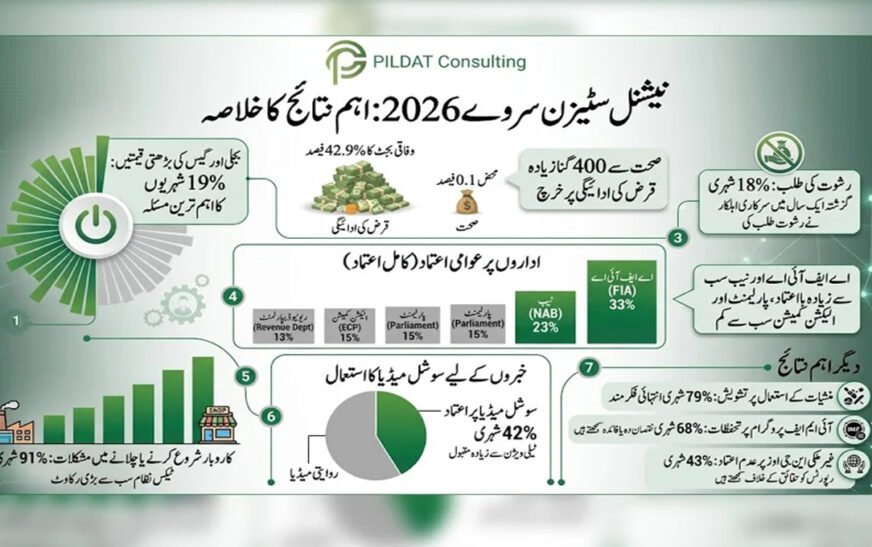
According to the survey, rising electricity and gas prices have emerged as the biggest concern for citizens across Pakistan, with 19% identifying increasing utility costs as the country’s number one challenge.
The report also highlighted a major imbalance in federal spending. It found that 42.9% of the federal budget is spent on debt servicing, while only 0.1% is allocated to health, making health spending around 400 times smaller than debt repayment expenditure.
Corruption and declining public confidence in government institutions also emerged as major concerns.
According to the survey, 18% of citizens—nearly one in five—said a government official had demanded a bribe from them during the previous year.
Starting or running a business was described as extremely difficult by 91% of respondents, with the existing tax system identified as the leading obstacle.
Public confidence in major institutions also remained limited. While 33% expressed complete trust in the FIA and 23% in NAB, only 15% said they fully trusted Parliament, while just 13% expressed complete confidence in the Revenue Department.
The survey found a major shift in how Pakistanis access news. Around 42% of citizens now prefer social media over television as their primary source of news.
However, 56% of respondents also believe the internet and social media are major contributors to the decline of social and moral values.
Other findings showed that 79% considered the growing use of drugs extremely dangerous, while 66% expressed serious concern over the country’s rising debt burden.
Around 60% said Pakistan’s education system has failed to meet the requirements of the modern economy, while 68% viewed International Monetary Fund (IMF) programmes as harmful or ineffective for ordinary citizens.
The survey also found that 43% of citizens viewed reports from foreign-funded NGOs and think tanks as inaccurate or influenced by an external agenda.
The nationwide survey was conducted between August 23 and September 5, 2026, based on face-to-face interviews with 5,155 adults.
The sample included proportionate representation from all four provinces, rural and urban populations, as well as different income and age groups.
IPOR independently handled the survey’s design and fieldwork, while PILDAT Consulting led the public release of the report and the Citizens Round Table.
During the discussion, PILDAT Consulting Executive Director Mamon Bilal, IPOR Executive Director Tariq Junaid, PIDE Chief Economist Dr Aram Batool and NAML University Professor Ashraf Ansari discussed the findings.
Participants agreed that addressing citizens’ actual priorities, strengthening institutional accountability and ensuring a fairer allocation of public funds are essential to tackling Pakistan’s ongoing challenges.