
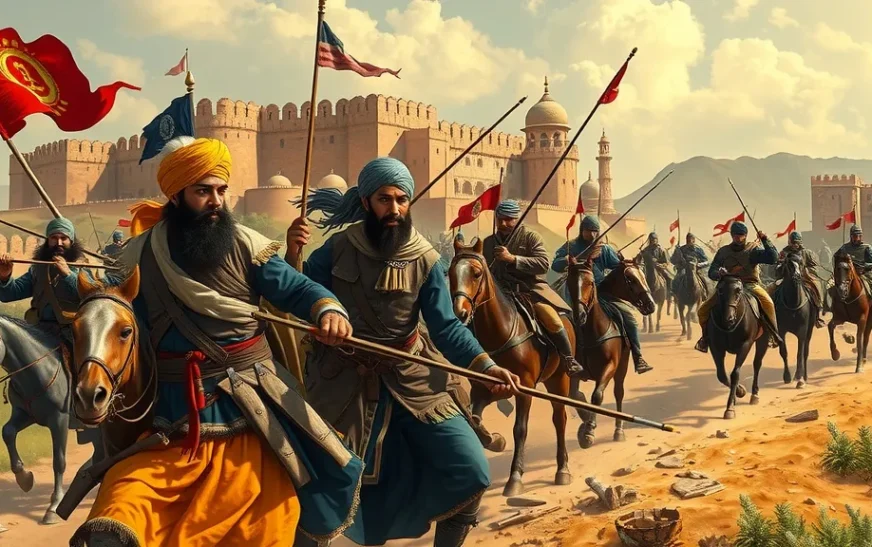
In the early 1800s, the frontier of Peshawar became the fault line between two powers: Maharaja Ranjit Singh’s expanding Sikh Empire, and the Afghan kingdom led by Dost Muhammad Khan Barakzai and his son Syed Muhammad Akbar Khan.
At the centre of Muslim resistance stood Syed Muhammad Akbar Khan, son of Dost Muhammad Khan of Kabul. He was not just a prince. He became a symbol of sacrifice for the people of the Khyber and Peshawar valley.1.
Akbar Khan grew up in Kabul’s royal court. In 1834, when news came that Sikhs were heavily taxing Muslims in Peshawar and disrespecting local mosques and customs, he left palace life behind. At just 18-19 years old, he took command of an Afghan army and marched through the harsh mountains of the Khyber Pass in winter.
No modern logistics, no guaranteed supplies — just tribal lashkars and loyalty. His sacrifice was giving up a secure princely life to lead a risky campaign against the most powerful army in North India at the time.
Ranjit Singh captured Peshawar in 1823 following the Battle of Nowshera, Sikh governors ruled the city for 11 years. In April 1834, Akbar Khan led his forces down from Kabul. He defeated the Sikh garrison and recaptured Peshawar, restoring the call to prayer and Afghan administration. For the people of Peshawar, this was the first time in over a decade they saw Muslim rule return. But holding it came at a cost. The Sikhs were too strong to stay away for long.
Akbar Khan had to retreat back to Kabul to avoid being cut off, knowing he couldn’t yet hold the city permanently. That withdrawal was itself a sacrifice — choosing to save his army to fight another day rather than risk total destruction.
The Sacrifice at Jamrud, 1837Akbar Khan’s biggest test came 3 years later at the Battle of Jamrud, 1837, at the mouth of the Khyber Pass. Sikh general Hari Singh Nalwa had built a fort at Jamrud to block Afghan entry into Peshawar.
Akbar Khan, now a seasoned commander, led the Afghan and tribal forces in a direct assault. The fighting was brutal and hand-to-hand. The Sikhs held the fort, but their legendary general Hari Singh Nalwa was killed.
The Afghan side also suffered heavy losses. Akbar Khan himself fought on the front lines. The sacrifice here was in blood — thousands of Afghan and Pashtun tribesmen died trying to push the Sikhs back from the gateway to Afghanistan.
After Jamrud, Sikh expansion into Afghan territory permanently stopped. Akbar Khan didn’t live to see a fully independent Peshawar. He later became Emir of Afghanistan and fought the British in the First Anglo-Afghan War. But in Peshawar’s memory, he’s remembered for three things: He gave up safety to lead from the front against Ranjit Singh, He gave the people of Peshawar hope by briefly restoring Muslim rule in 1834. He bled with his men at Jamrud to draw the line the Sikhs could not cross
Pashtun poets and historians still call him “Ghazi Akbar” — the warrior prince who chose jihad and state duty over palace comfort. Syed Muhammad Akbar Khan’s sacrifice wasn’t just one battle. It was years of campaigning in brutal terrain, losing men, losing and retaking cities, and putting the defence of Muslim lands in the northwest frontier above his own throne.
After the First Anglo-Afghan War 1839-1842, Akbar Khan became the most powerful man in Afghanistan. He led the uprising that drove the British out of Kabul in 1841 and was briefly the ruler of Kabul.
Rivalry with his father: When his father Dost Muhammad Khan returned from exile in 1845 and regained the throne, tensions grew between father and son over who should control the state.
On September 14, 1845 in Talghan, northern Afghanistan Akbar Khan was sent by his father to deal with rebellions in the north. While staying in Talghan, he suddenly fell ill and died within days allegedly due to poisoning.
Contemporary sources, including Afghan court chronicles and British observers, believed he was poisoned likely on the orders of political rivals at court who saw him as a threat to Dost Muhammad’s authority. The exact poisoner was never proven. He buried in Kabul.
Read also: Aurangzeb Calls Operation Bunyan ul-Marsous a “Bright Chapter” in Pakistan’s History