

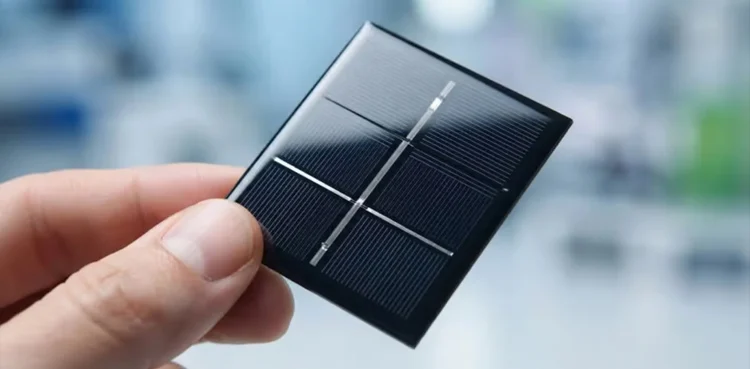
Chinese scientists have developed a new technique to improve the efficiency and durability of organic solar cells, bringing the flexible technology closer to conventional silicon-based solar panels.
Researchers at the Ningbo Institute of Materials Technology and Engineering in China have achieved a power conversion efficiency of 20.4% in organic solar cells using a new molecular bonding technique. The findings were published in the scientific journal Joule on October 21.
Unlike conventional solar panels, which primarily use silicon to convert sunlight into electricity, organic solar cells rely on carbon-based materials. They are lightweight, flexible and, in some cases, transparent, making them suitable for applications where traditional rigid solar panels are difficult to install.
These cells could potentially be integrated into buildings, vehicle roofs, smartwatches and other surfaces that cannot easily accommodate heavy or inflexible solar panels.
However, their long-term durability has remained a major challenge. Prolonged exposure to sunlight and high temperatures can weaken the bonds between different layers of a solar cell, including the interface between the electrode and the solar film. Over time, these layers can separate, reducing performance and potentially causing the cell to fail.
To address this problem, the Chinese research team introduced an ultrathin layer of indium chloride between the electrode and the solar film. When heated, the layer triggers a chemical reaction that creates strong chemical bonds between the two components.
According to the researchers, the technique strengthens the connection between the cell’s layers, significantly reducing the risk of separation during prolonged exposure to heat and light.
Laboratory-scale solar cells developed using the method achieved a power conversion efficiency of 20.4%, demonstrating the technology’s potential to improve the performance of organic photovoltaics.
The researchers subsequently tested the technique on a larger module measuring 15.6 square centimetres. The module achieved an efficiency of 18.8%, which the team described as a record result.
The findings could help address two major limitations of organic solar technology: efficiency and durability. If further testing confirms the cells’ long-term stability and the method proves suitable for large-scale manufacturing, the technology could expand the use of lightweight and flexible solar power in buildings, vehicles and wearable electronic devices.
Read also: Pakistani Students Can Apply for Scholarships in Sweden














1 Comment
[…] Read also: A New Era for solar energy, Scientists announce major breakthrough […]