

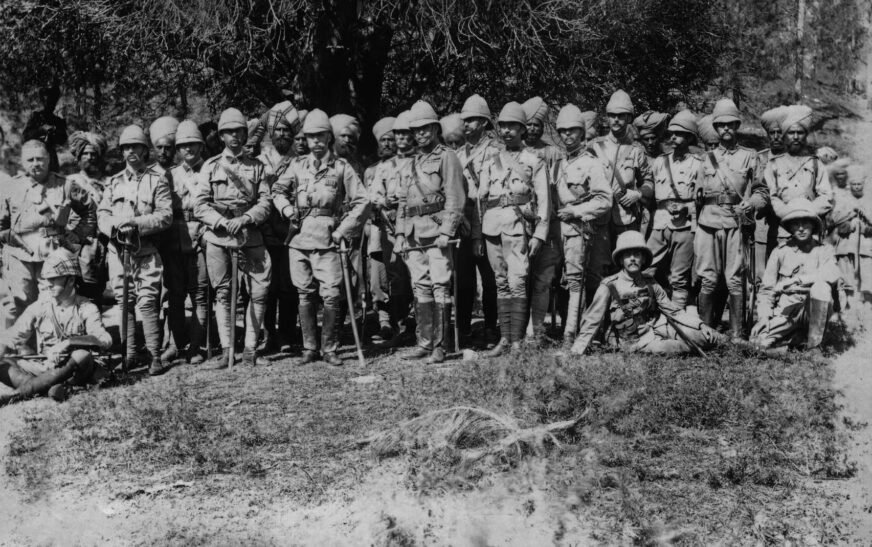
The Battle of Malakand was a major conflict during the British colonial period in what is now Khyber Pakhtunkhwa, Pakistan. It happened during the Pashtun uprising of 1897 against British rule.
In the late 1800s, the British were trying to extend control over the tribal areas on the northwest frontier of British India. In 1895, they built Fort Malakand and Fort Chakdara to guard the route into Swat, Dir, and Chitral. Locals saw this as interference in tribal autonomy and religion. Religious leaders, especially Saidullah, a Pashtun preacher known as the “Mad Fakir” or “Sartor Faqir of Buner”, began preaching jihad against the British.
The Siege – 26 July to 2 August 1897
On the night of 26 July 1897, thousands of Pashtun tribesmen from Swat, Buner, Dir, and Bajaur attacked Fort Malakand. The fort was defended by a small British-Indian garrison of about 1,000 men under Brigadier-General Alfred Meiklejohn. The attackers set fire to buildings and launched repeated assaults. After heavy fighting, British reinforcements arrived from Nowshera. The most famous officer involved was Lieutenant Winston Churchill, who was then a war correspondent and young army officer.
He later wrote about it in his book The Story of the Malakand Field Force. By August 02, 1897, the tribesmen withdrew. The British then launched a punitive expedition into Swat and Buner to break resistance. British Indian Army was led by Meiklejohn, later Sir Bindon Blood while the Tribal side led by religious leaders including Sartor Faqir.
British held the forts, but tribal resistance continued for weeks. The uprising was eventually suppressed after great sacrifices of Pakhtun tribes. It was part of the larger Frontier Uprising of 1897 that also included battles in Tirah and Chitral. It showed how hard it was for the British to control the tribal areas. It brought Winston Churchill international attention. His accounts made him famous as a writer. The Malakand Agency was later kept as a “politically administered” tribal area, not fully annexed. Today, Malakand is remembered in Pakistan as an example of early Pashtun resistance to colonial rule.
On July night in 1897, the drums started in the hills. For the British officers inside Fort Malakand, it was just another evening on the Frontier. By dawn, that quiet was gone. Thousands of Pashtun tribesmen had come down from Swat, Dir, Buner and Bajaur, answering the call of a fiery preacher known as the “Sartor Faqir” or “Mad Fakir”. Their message was simple, the British had to go.
That night marked the beginning of the Battle of Malakand — one of the fiercest episodes of resistance against colonial rule on what is now the Khyber Pakhtunkhwa border. A Fort on Shaky Ground. The British had built Fort Malakand and Fort Chakdara just two years earlier to guard the road into the princely states of Swat and Chitral.
To London it was “strategy”. To the tribes, it was an invasion of their land, their customs, and their faith. The tension had been building for months. In mosques and hujras, the Sartor Faqir preached jihad. On July 26, the spark caught. Seven Days Under Siege. About 1,000 British and Indian soldiers were inside Fort Malakand that night, commanded by Brigadier-General Alfred Meiklejohn. They were outnumbered many times over.
The attackers burned the bazaar, cut telegraph wires, and charged the walls again and again. For seven days the fort held, with rifles flashing and bugles calling for reinforcements from Nowshera. Among the young officers watching it all was 23-year-old Lieutenant Winston Churchill, sent not just to fight but to write.
His dispatches and later his book The Story of the Malakand Field Force turned the siege into front-page news in Britain. “The tribesmen fought with a courage that would have done credit to the best troops,” he wrote.
By August 2, with British reinforcements arriving, the tribes withdrew to the hills. The forts stood, but the Frontier had shown its teeth. More Than a Battle The Malakand siege was not an isolated clash. It was the opening act of the Frontier Uprising of 1897, which spread across Tirah, Kurram, and Chitral. The British responded with large “punitive expeditions,” burning villages and imposing fines. Yet the uprising left a mark. The British never fully annexed the tribal belt. Instead, Malakand became a “politically administered” area — ruled indirectly, always uneasy, always armed. In local memory, Malakand is remembered differently.
Not as a footnote in Churchill’s career, but as an early chapter of Pashtun resistance — where maliks, mullahs, and ordinary farmers stood together against an empire.
Today, the road through Malakand Pass is busy with trucks, schools, and markets. The old fort walls are mostly gone and churchil check posts is still exist while elders in Batkhela and Dargai still tell the story of the summer when “the hills came down.”
The Battle of Malakand didn’t change maps. But it changed minds — on both sides. For the British, it was proof that the Frontier could not be ruled like Punjab. For the people here, it was proof that resistance exist in the blood of Pakhtoons.
Read also: ANP Rejects Tax Imposition in Malakand, Merged Districts







2 Comments
[…] DIR: Residents of Upper Dir have welcomed a proposal to turn Khyber Pakhtunkhwa’s Malakand Division into a separate province, while several political figures have emerged as potential candidates for […]
[…] Read also:Battle of Malakand Pass 1897: The story of resilience and bravery […]