

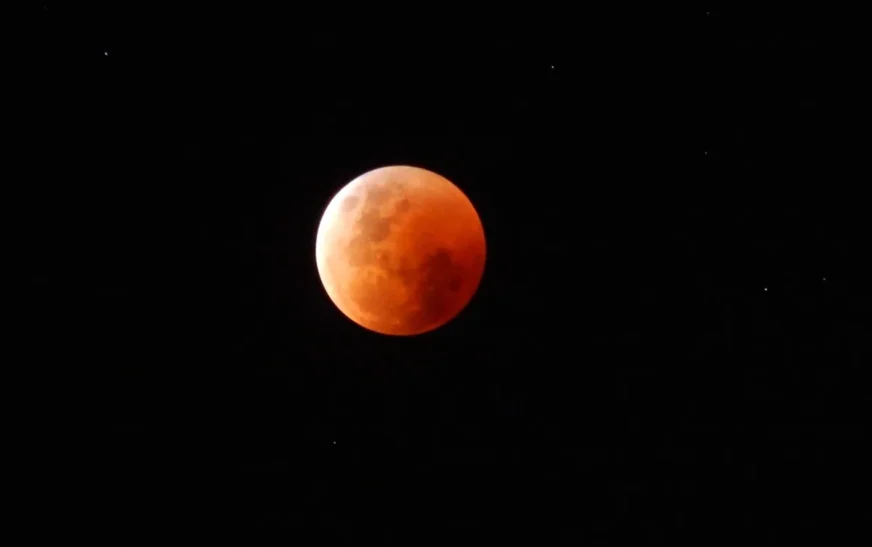
WASHINGTON — Astronomers and stargazers across the globe are preparing for one of the most striking celestial events of the year, as a deep partial lunar eclipse lights up the night sky on August 27–28, 2026.
While technically classified as a partial lunar eclipse rather than a total alignment, the upcoming event will feature an impressive 96.2% of the Moon’s surface plunging directly into Earth’s darkest shadow, the umbra. This extensive coverage is expected to paint the lunar disk in dramatic, coppery reddish-orange hues, delivering a classic “blood moon” visual experience for millions of observers.
According to astronomical tracking networks, the celestial alignment will be widely visible across the Americas, Europe, and Africa. In North America, the event kicks off on the evening of August 27, with the main partial phase starting at 10:33 p.m. EDT. The eclipse will reach its maximum peak intensity shortly after midnight at 12:12 a.m. EDT on August 28 (04:12 GMT), before concluding in the early morning hours.
Skywatchers situated outside the visibility zones—including parts of Asia and Australia, where the event occurs during daytime hours—will miss out on the direct view, though numerous online platforms plan to host live streams.
Unlike solar eclipses, astronomers emphasize that lunar eclipses are entirely safe to view with the naked eye, requiring no special protective eyewear, filters, or equipment.
Read also: SUPARCO announces launch of Pakistan’s first Lunar rover in 2028