

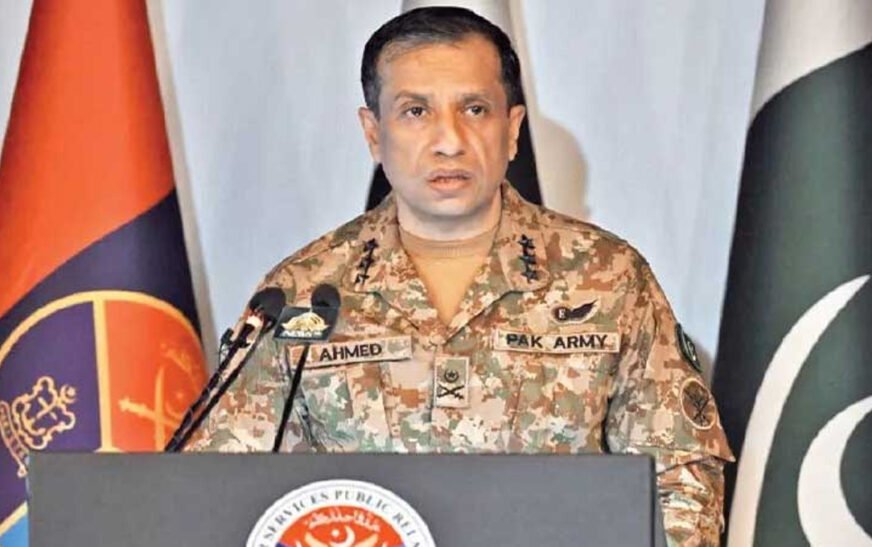
RAWALPINDI: Director General of Inter-Services Public Relations (ISPR) Lieutenant General Ahmed Sharif Chaudhry on Friday said Afghan nationals were involved in most of the recent suicide attacks carried out in Pakistan, while reaffirming the state’s commitment to eliminating terrorism through sustained military and intelligence-led operations.
Addressing a detailed press briefing, the military spokesperson said that out of 28 suicide attacks recorded in the country this year, the majority of the suicide bombers were Afghan citizens. He added that Afghan terrorists were also involved in recent attacks in Tank and Karachi.
He said that the Afghan Taliban regime and India’s Rashtriya Swayamsevak Sangh (RSS) share the same DNA. He said that terrorist groups operating against Pakistan were receiving support from hostile elements linked to India and militant networks based in Afghanistan.
Providing an overview of counterterrorism efforts, Lt Gen Chaudhry said security forces, police, law enforcement agencies and intelligence organisations had conducted 40,348 intelligence-based operations (IBOs) across the country so far this year.
He said the operations resulted in the elimination of a large number of verified terrorists and inflicted significant damage on militant networks.
According to the DG ISPR, a total of 819 Pakistanis have embraced martyrdom in terrorism-related incidents this year, including 303 personnel of the Pakistan Army, 194 police and law enforcement officials, and 322 civilians.
He said 3,145 terrorism-related incidents were reported nationwide during the period, including 1,971 in Khyber Pakhtunkhwa, 1,148 in Balochistan and 26 in other parts of the country.
Comparing current figures with those of last year, Lt Gen Chaudhry noted that 2,597 terrorists were killed during 2025, while 2,084 militants had already been neutralised this year despite only part of the year having elapsed. He said the figures reflected the increased intensity and effectiveness of counterterrorism operations.
The military spokesperson maintained that the rise in certain terrorist incidents was partly linked to intensified pressure on militant groups. He said that after facing setbacks inside Pakistan, terrorist organisations had expanded their activities and support networks from areas in Afghanistan under Taliban control.
“The state’s position is now absolutely clear. There is no room for compromise or concessions for terrorists,” he said, adding that militants had only two options: surrender before the state in accordance with the Constitution and law or face military action.
Discussing Balochistan, Lt Gen Chaudhry rejected what he described as a negative narrative surrounding the province, arguing that many claims of deprivation did not align with ground realities.
He said the province’s fundamental challenge was not terrorism alone but an outdated tribal and feudal system that had deprived ordinary citizens of opportunities for education, economic progress and social mobility.
“The real issue in Balochistan lies with certain sardars and elite elements who seek to preserve an exploitative system for their own interests,” he said.
The DG ISPR alleged that some influential groups benefited from smuggling, narcotics trafficking and other illegal activities and resisted reforms aimed at strengthening the writ of the state. He claimed that terrorism and instability were often exploited to create pressure for political concessions.
Highlighting development indicators, he said Balochistan had witnessed significant progress in education, healthcare, infrastructure and public services since Pakistan’s independence. He cited the expansion of educational institutions, hospitals, road networks and development projects, including those in Gwadar and Turbat.
Lt Gen Chaudhry also rejected allegations that the military was running the affairs of the state, stressing that Pakistan’s institutions function under the Constitution and the rule of law.
“The military is not running state affairs. Pakistan is governed through constitutional and legal mechanisms, and all institutions operate within their defined roles,” he said.
The DG ISPR further emphasised the importance of national identity, urging citizens to place their Pakistani identity above ethnic, linguistic and regional affiliations.
He also called on citizens to fulfil their constitutional responsibilities alongside exercising their rights, saying loyalty to the state and adherence to the Constitution formed the foundation of a strong and stable Pakistan.
Speaking on good governance, DG ISPR said Pakistan’s security depends on effective governance and institutional reforms. He observed that while the country’s population has grown almost four times, Pakistan still has only four provinces, suggesting that governance arrangements should be reviewed to better meet the needs of a growing population.
Concluding the briefing, Lt Gen Chaudhry said security forces, police and intelligence agencies would continue their coordinated efforts against terrorism and vowed that operations would persist until peace and stability were fully restored across the country.