
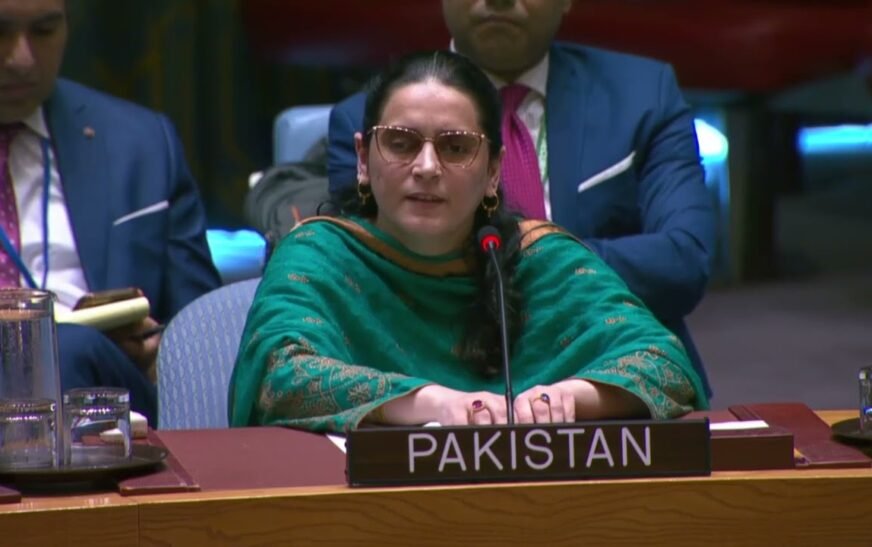
Second Secretary on Human Rights for Pakistan’s Permanent Mission to the United Nations in Geneva Saima Saleem said that it is ridiculous for India to teach a lesson of peace, which itself is guilty of violating international law and Security Council resolutions, aggression against neighbours and state-sponsored terrorism in the region.
She said that there is a clear difference between the conditions in Azad Jammu and Kashmir and the illegally occupied Jammu and Kashmir by India. Saima Saleem said that on one side there is political freedom and on the other side there is a series of repression, arrests and human rights violations. The exercise of rights and the deprivation of rights cannot be the same thing.
She said that the inalienable right of the Kashmiri people to self-determination cannot be denied, Jammu and Kashmir is neither an integral part of India nor an internal matter, India’s denial cannot change the international status of this dispute.
Counsellor Saima Saleem said that India itself brought the Kashmir issue to the Security Council and today is deviating from the resolutions, repression and human rights violations are ongoing in occupied Kashmir.
She further said that the Indian decision to suspend the Indus Waters Treaty is a violation of international law, the water of the Indus River is a source of life, not a weapon of war. Saima Saleem also said that terrorist networks linked to India have spread globally, and Hindutva ideologies in India have made Islamophobia a state policy.
Who is Saima Saleem? Her story of Resilience
Saima Saleem is a Pakistani civil servant and diplomat. She made history as the first visually impaired Pakistani woman to be employed by the Federal Government and to join the country’s diplomatic service. Today she serves as the Second Secretary on Human Rights for Pakistan’s Permanent Mission to the United Nations in Geneva.
Saima completed her bachelor’s and MPhil in English literature from Kinnaird College for Women University. She graduated in the first division in both degrees and won gold medals for her outstanding performance. She was also ranked among the top students among hundreds of sighted students.
In two thousand seven, she passed the Central Superior Services (CSS) exam with remarkable success, securing a top position overall and the first position among women candidates. Saima’s journey has not been easy.
In her childhood she was diagnosed with retinitis pigmentosa, an incurable eye disease. Over time she gradually lost her sight, and by the age of thirteen she had lost her vision completely.
Disability runs in the family too. Saima has four siblings, two of whom are also blind. Her brother Yousaf Saleem became the first blind judge of Pakistan, and her sister, who is also visually impaired, works as a lecturer at the University of Lahore.
Saima began her professional life as a lecturer at Kinnaird College for Women, where she taught for a year. Her real ambition, however, was to join the Foreign Service.When she applied to sit the CSS exams, she requested the Federal Public Service Commission to allow her to take a computer-based test instead of a paper-based one. Initially the request was denied, but Saima did not give up.
She quoted a government ordinance that promised facilitation for candidates with visual impairment. With the support of her school director and the approval of the President’s office, she was finally permitted to take the exam on a computer. After clearing the exam, another barrier appeared. At the time, blind candidates were not allowed to join the Foreign Service. Saima challenged this too.
During her interview she was asked if she was satisfied with the groups allocated to her. She replied that in a competitive exam, candidates should get the group according to their merit and position.
Her recommendation was sent to the Prime Minister, who approved it as an exception. Saima joined the Foreign Service of Pakistan and served in different roles at the Ministry of Foreign Affairs, including as Assistant Director for China and as Assistant Director for the Security Council and Human Rights.
Later she was appointed as Second Secretary on Human Rights at Pakistan’s Permanent Mission to the United Nations in Geneva. She has also served as Deputy Secretary in the Prime Minister’s Secretariat.
Throughout her academic and professional life, Saima has received numerous honors. She was awarded the Quaid-e-Azam Gold Medal for academic excellence and secured the first position in the Punjab Public Service Commission exam.
She has also received the Women Achievement Award and the Madar-e-Millat Fatima Jinnah Medal. During a visit to Switzerland for the World Economic Forum, she was commended by the then Prime Minister of Pakistan.
Saima Saleem’s story is one of determination, courage, and breaking barriers. Despite losing her sight at a young age, she pursued education, cleared one of the toughest exams in the country, and went on to represent Pakistan on international forums.
Read also:How Pakistani diplomat Saima Saleem responded to Indian allegations in UN?