

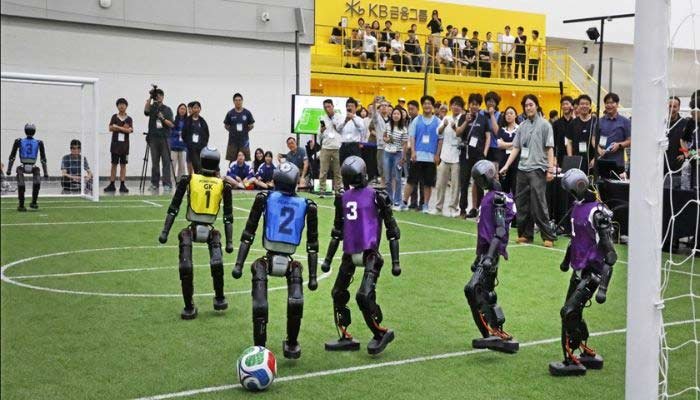
The RoboCup 2026, often described as the Football World Cup for robots, has officially kicked off at Songdo South Korea, drawing thousands of researchers, engineers, and robotics enthusiasts from across the globe.
The five-day event has brought together nearly 3,000 participants from 45 countries to showcase the latest breakthroughs in robotics, artificial intelligence (AI), and autonomous technologies through a series of competitions, demonstrations, and exhibitions.
The centrepiece of the event is the highly anticipated RoboCup football tournament, where teams of fully autonomous humanoid robots compete against one another without any direct human control. Equipped with advanced AI systems, the robots dribble, pass, and shoot in coordinated attempts to score goals while making real-time decisions on the field.
Images and videos from the tournament highlight the remarkable progress in robotic technology, with machines displaying increasingly sophisticated movement and teamwork. However, the matches also reveal the challenges that remain, as some robots occasionally lose balance and tumble during play, reflecting the continuing gap between robotic and human athletic performance.
According to organisers, RoboCup serves as a real-world testing ground for researchers to evaluate how autonomous robots perceive their surroundings, make decisions, and respond to rapidly changing situations without human intervention.
Founded in 1997, RoboCup was launched with an ambitious vision to develop a team of fully autonomous humanoid robots capable of defeating the human football world champions. Over nearly three decades, the competition has grown into one of the world’s leading robotics events, driving advances in AI, machine learning, computer vision, and autonomous systems.
Although organisers acknowledge that defeating the world’s best human footballers remains a distant goal, they believe each edition of RoboCup represents another significant milestone in the journey towards creating intelligent, fully autonomous robotic athletes.
Read also: AI and robotics education introduced in public schools