

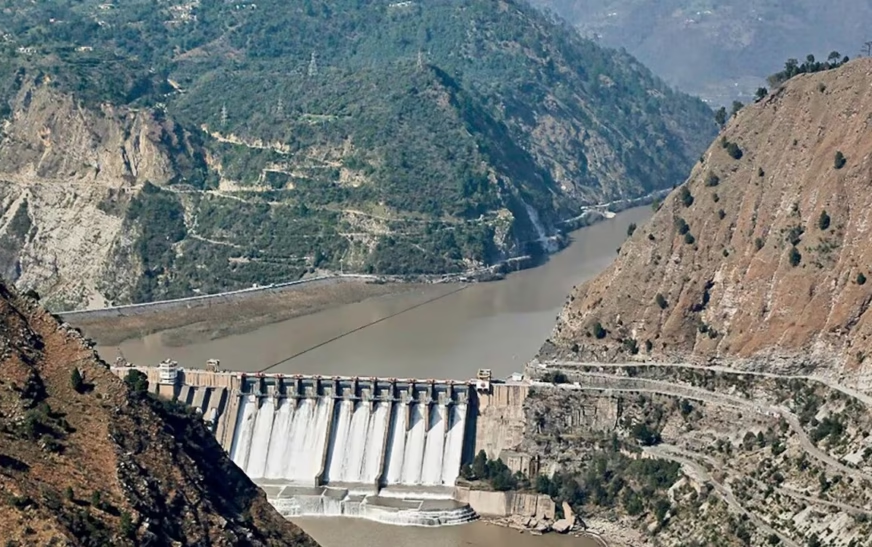
The Government of Pakistan expresses its utmost satisfaction with the Court of Arbitration’s Supplemental Award concerning Maximum Pondage, issued on May 15, 2026, in the Indus Waters Treaty proceedings related to the Ratle Hydroelectric Plant and the Kishenganga Hydroelectric Project design disputes.
The Award upholds Pakistan’s assertion that the Treaty imposes significant limits on India’s control over water from the Western Rivers. These limits are not mere formalities; they must be adhered to during the planning and design stages and cannot be satisfied simply by later assurances of operational restraint. The pondage for a Run-of-River Plant must be justified based on actual project needs, expected operations, site hydrology, hydraulic conditions, power-system requirements, and the information and explanations required under the Treaty.
Building on the Court’s General Issues Award from August 8, 2025, the Supplemental Award enforces the standard that installed capacity and anticipated load must be realistic, well-founded, and defensible. The installed capacity must reflect actual expected operations, taking into account hydrologic and hydraulic data, as well as Treaty stipulations. The anticipated load must correspond to the actual expected operation and the projected needs of the power system that the plant is intended to serve.
This highlights a crucial concern of the Treaty: India cannot justify increased pondage based on hypothetical capacity, artificial load curves, unrealistic peaking assumptions, or mere claims of compliance with Paragraph 15 release limits. While Paragraph 15 remains an operational constraint, it is not a substitute for a justification of the sought water-control capacity that is based on evidence. Any alternative operating pattern must be backed by specific information and supporting data provided by India.
The Award also reinforces Pakistan’s review rights, stipulating that India must furnish sufficient information and explanations to allow Pakistan to assess Treaty compliance. Should India fail to provide this information, it does not meet its obligation to demonstrate that the proposed maximum pondage aligns with Paragraph 8(c) of Annexure D.
Additionally, the Court confirmed that any applicable minimum-flow obligations must be considered when calculating the pondage required for Firm Power, provided such obligations exist and are not otherwise fulfilled. The requirements of Paragraph 15 do not automatically meet these obligations.
Pakistan also acknowledges the Court’s earlier ruling that decisions made by a Court of Arbitration are final and binding on both Parties and possess controlling legal effects for subsequent Treaty bodies regarding relevant issues of Treaty interpretation. Pakistan will present these interpretations to the Neutral Expert process, in accordance with Treaty procedures and confidentiality arrangements.
Pakistan remains committed to the Indus Waters Treaty, its dispute-resolution procedures, and the peaceful resolution of water-related disputes. The country will continue to protect its rights under the IWT and will utilize all lawful and diplomatic means to ensure that hydroelectric projects on the Western Rivers are designed and operated strictly within the Treaty’s limits.
This Award serves as a strategic reinforcement of Pakistan’s position regarding the Treaty: maximum pondage must be realistic, evidence-based, hydrologically grounded, justified by power system needs, compliant with Treaty requirements, and impervious to inflation through artificial assumptions.














1 Comment
[…] The Permanent Court of Arbitration (PCA) in The Hague has ruled that India must comply with the Indus Waters Treaty (IWT) with Pakistan and limit work on hydroelectric projects in the disputed Kashmir […]