
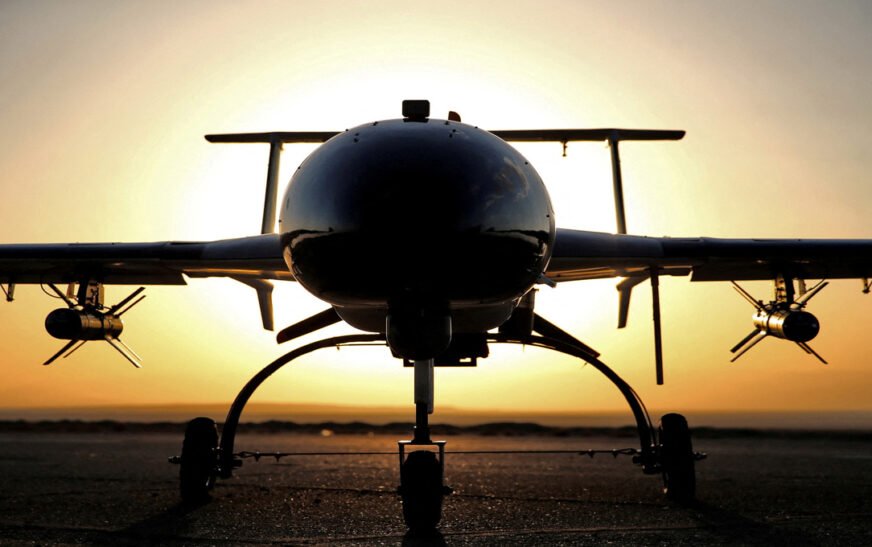
TEHRAN: The world was shocked to discover that Iran was supplying drones to the Russian army, thus dramatically changing the global balance of power. This information followed previous reports about the use of Iran’s drones by Hezbollah near the Israeli borders and by the Houthis in Yemen. However, news of Iran’s cooperation with Russia grabbed more attention due to the emergence of images of the Shahed-136 (Geranium-2) drones in Ukraine’s airspace.
The key question remains: how did a country under international sanctions for over 40 years manage to change the game in global conflicts? What core values and factors enabled Iran to achieve success in the drone technology sector?
Everything started with the sanctions imposed on Iran since 1979, which made Iranian authorities reconsider their strategy and use everything they could find in their own country. Sanctions forced Iran to rely on its local engineers and manufacture weapons themselves, creating underground channels for purchasing necessary parts from abroad.
After the 1979 revolution, Iran inherited a powerful military infrastructure, but the downfall of the Shah’s regime left the country in disarray. By 1980, Iran was thrust into a brutal eight-year war with Iraq, which claimed nearly a million lives. With its military leadership decimated and lacking advanced technology, Iran faced a dire need for innovation in warfare.
Unable to purchase foreign technology due to ongoing sanctions, Iranian engineers and researchers began developing their own solutions. In the early 1980s, they started working on small-scale aerial devices, initially envisioned as reconnaissance tools equipped with cameras. The first model was presented to military officials in 1983, who initially mocked the design. Despite doubts, the drone successfully flew over Iraqi military positions, returning with usable reconnaissance footage.
This early success led to the establishment of the Thunder Battalion and the beginning of a formal drone program. The project, which had started as a student initiative at Isfahan University, soon evolved under the supervision of the Revolutionary Guard commanders, marking the beginning of Iran’s successful foray into drone technology.
Today, Iran’s drone capabilities have changed the calculus of modern warfare and are seen as a powerful tool in both regional conflicts and international diplomacy.
Where are Iran’s frozen assets? Which countries are holding billions?
Meanwhile, as the United States and Iran engage in key dialogues, one of the key demands from Tehran is the release of its frozen assets, which have been held abroad for years due to international sanctions. Although specific amounts are difficult to confirm, estimates by Iranian officials indicate that Iran’s frozen assets are valued at more than $100 billion.
Iran’s frozen assets are mainly comprised of revenues generated from oil exports, among other sources of income. As a result of several sanctions levied by other countries, including America, the money has remained frozen within financial institutions abroad. Sanctions on Iran have been ongoing since 1979 following the Iranian Revolution, as well as fears over Iran’s nuclear ambitions.
As per the available literature, some of the countries holding the majority of Iran’s frozen assets include China, India, and Iraq. For example, China holds more than $20 billion worth of assets belonging to Iran, whereas India holds about $7 billion. Similarly, the amount owned by Iraq stands at approximately $6 billion, followed by Qatar and Japan with $6 billion and $1.5 billion, respectively.
In the United States, Iranian assets totaling nearly $2 billion remain blocked, and European nations also hold frozen funds. Luxembourg, for example, has around $1.6 billion of Iran’s assets in its banks.
For Iran, the restoration of these assets holds significant importance. The country’s economy has undergone a lot of pressure owing to sanctions imposed against it, resulting in inflation and a fall in the exchange rate of the currency. Specialists say that the release of such frozen funds will be greatly beneficial for Iran as it will give relief to its economy and help it to develop infrastructure and progress from the aftereffects of the war.
It is expected that the issue will play a critical role in the upcoming negotiations between Iran and the US.