
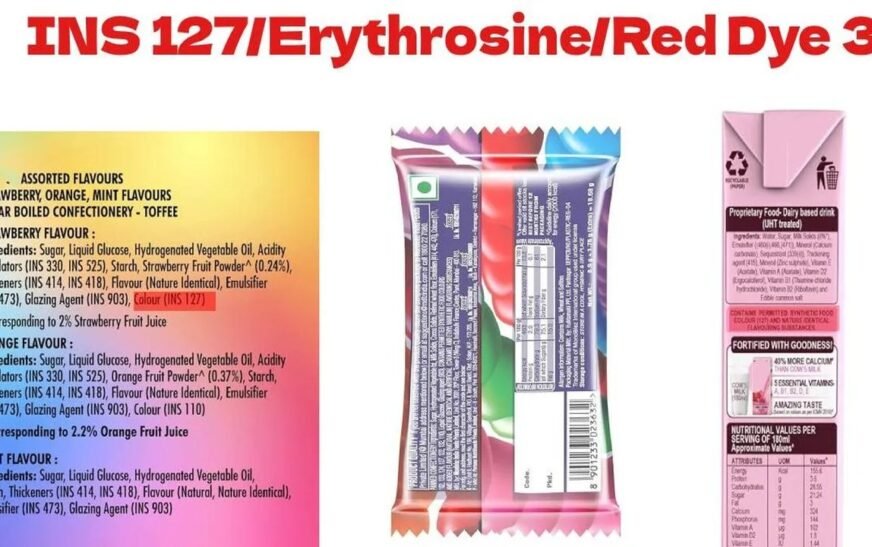
The colour additive INS 127, commonly used in strawberry-flavoured milkshakes, ice cream, candies, bubble gum, and waffles in India, has been banned in the USA by the Food and Drug Administration (FDA) due to its cancer-causing properties in rats. Despite this, many brands in India, whether well-known or newly established, continue to use INS 127, also referred to as Red No. 3 or Erythrosine.
As reported by South First, the FDA stated, “We have found that FD&C Red No. 3 can induce cancer in male rats through a rat-specific hormonal mechanism. Therefore, we are revoking the listings for these uses of this colour additive under section 721(b)(5)(B) of the FD&C Act, as a matter of law.”
In India, under the Food Safety and Standards (Food Products Standards and Food Additives) Regulations, 2011, Erythrosine, also known as FD&C Red No. 3, is recognised as a synthetic food colour. According to the International Numbering System (INS) for Food Additives, it is designated as INS 127.
In India, INS 127 is permitted for use in the following products:
– Powdered soft drinks
– Concentrated mixes/fruit beverages
– Custard powder
– Jelly crystals
– Ice candies
– Thread sweets
– Candies
– Wafers
– Flavour emulsions
– Flavour pastes (for carbonated and non-carbonated water only)
– Chewing gum
– Bubble gum
Erythrosine is primarily utilised to impart a bright red hue to various food items, such as candies, baked goods, and beverages. It enhances the visual appeal of products like cakes, cookies, frostings, and frozen desserts. However, concerns have been raised regarding its potential carcinogenic properties. Studies have indicated that Erythrosine can cause cancer in laboratory rats, prompting scrutiny over its safety in food products.
While Erythrosine is still allowed in food products in India, the regulatory landscape is gradually changing. The FDA’s recent decision to ban Erythrosine in food and ingested drugs due to health concerns may influence regulatory practices in other countries, including India. The additive has also been linked to behavioural issues in children. For instance, a 2021 report by the California Office of Environmental Health Hazard Assessment found that children who consumed Red Dye 3, along with other food dyes, were more likely to experience hyperactivity and difficulty concentrating.
Growing consumer awareness of the potential risks associated with synthetic dyes like Erythrosine has led to shifts in the food industry. As a result, some manufacturers are actively reformulating their products to eliminate such additives.
On January 15, U.S. regulators banned the dye known as Red 3 from the nation’s food supply, nearly 35 years after it was prohibited in cosmetics due to potential cancer risks. The FDA stated, “We are revoking the authorisation for the use of FD&C Red No. 3 based on the Delaney Clause of the Federal Food, Drug, and Cosmetic Act (FD&C Act).” This clause, enacted in 1960, prohibits the FDA from authorising a food additive or colour additive that has been found to induce cancer in humans or animals.
According to the FDA, “Data presented in a 2022 colour additive petition show that this ingredient causes cancer in male laboratory rats exposed to high levels of FD&C Red No. 3 through a hormonal mechanism specific to male rats.” However, the agency noted that studies in other animals and in humans did not show the same effects, and there is no evidence suggesting that FD&C Red No. 3 causes cancer in humans.
The FDA emphasised, “Colour additives, including FD&C Red No. 3, require pre-market review and approval. The law requires evidence that a colour additive is safe under its intended conditions of use before it may be added to foods.”
When manufacturers seek approval for a colour additive, they submit a petition with data and information. The FDA evaluates this data, considering factors such as the likely amount of consumption, intended use, manufacturing processes, and the physical and chemical properties of the additive. “If the data available demonstrates that the substance is safe under the proposed conditions of use, the agency issues a regulation authorising its use,” the FDA stated.
However, “In cases where data demonstrate that a colour additive intended for ingestion can induce cancer in humans or animals based on appropriate tests, the Delaney Clause directs the FDA to find such uses unsafe,” the agency clarified.
The FDA also explained its labelling regulations: “Certified colours must be declared in the statement of ingredients on food labels as ‘FD&C Red No. 3,’ or without the ‘FD&C’ prefix or the term ‘No.’ – for example, ‘FD&C Red 3’ or ‘Red 3.’”
Other countries may allow the use of FD&C Red No. 3 under different regulations, but the concerns regarding its safety remain a significant topic of discussion globally.
Read also: Pakistan secure victory against India in U19 Asia Cup