
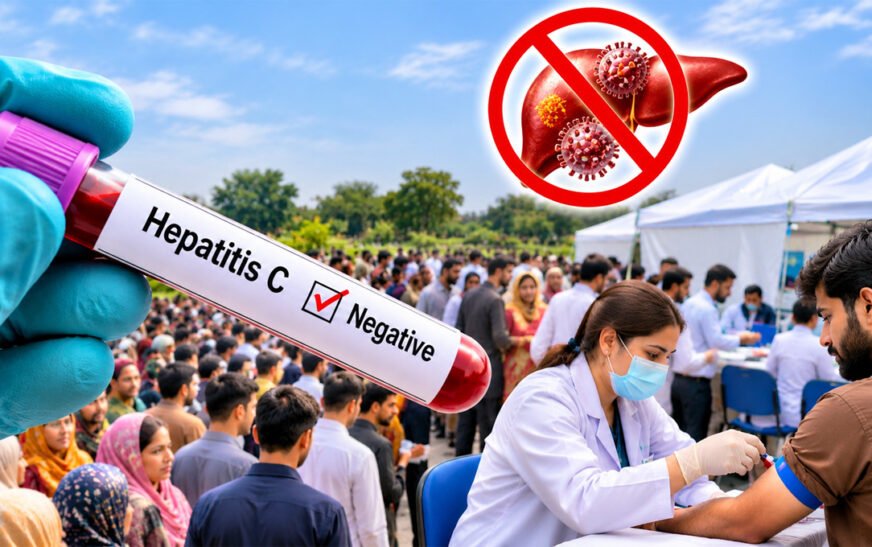
ISLAMABAD: Islamabad is preparing to launch a large-scale hepatitis C screening campaign targeting about 1.7 million residents aged 12 and above, aiming to make the federal capital Pakistan’s first hepatitis C-free model city.
The initiative will involve widespread testing across urban and rural communities, bringing healthcare services directly to people’s doorsteps. According to officials, around 46 percent of the targeted population resides in urban sectors, while the remaining 54 percent lives in rural areas.
The campaign is part of the government’s broader efforts to eliminate hepatitis C across Pakistan through early detection, timely diagnosis and access to treatment.
Task force member Professor Dr. Saeed Akhter and Pakistan Medical and Dental Council (PMDC) President Professor Dr. Rizwan Taj recently briefed representatives of universities and medical and dental colleges about the initiative at the council’s headquarters.
Officials said Prime Minister Shehbaz Sharif had launched the national hepatitis elimination programme and was personally monitoring the allocation of funds and resources to ensure its effective implementation.
Thousands of Volunteers to Take Part in Screening Drive
The Islamabad campaign will rely on an extensive network of healthcare workers, students and community volunteers.
Approximately 9,000 medical and nursing students will participate in the initiative as part of their community service training. Faculty members will supervise their activities, while around 100 personnel from the Ministry of Health and the District Health Office will provide additional support.
Volunteers will also be recruited through local elected representatives to strengthen community participation.
To cover the entire capital, authorities plan to deploy approximately 4,500 teams, each comprising two members, across different sectors and union councils.
One team member will conduct a finger-prick blood test, similar to the procedure used for blood sugar testing, while the other will record the information in the National Database and Registration Authority (NADRA) system.
Screening teams will visit residential neighbourhoods as well as schools, universities, religious seminaries, government and private offices, and commercial markets to reach as many people as possible.
What Happens If Someone Tests Positive?
Those people who get positive results during their initial screening test would be sent to the nearest health center for further evaluation.
The blood samples of the patient will be collected by the doctors for Polymerase Chain Reaction (PCR) testing to determine the presence of the hepatitis C virus in the body of the individual.
Moreover, the AST to Platelet Ratio Index (APRI) will also be calculated to estimate the possible damage to the liver of the patient.
All these tests would help the medical team to diagnose the patients.
Egypt’s Hepatitis Elimination Model Inspires Initiative
The suggested campaign has been derived on the basis of the screening and treatment of the hepatitis C that has been carried out all across Egypt for around six years now. The government officials are of the view that if the results prove to be fruitful, Islamabad can set an example for the other cities to follow.
In case the programme is able to accomplish its aims and goals in Islamabad, the same will be replicated in the whole of Pakistan to make Pakistan hepatitis C free.