
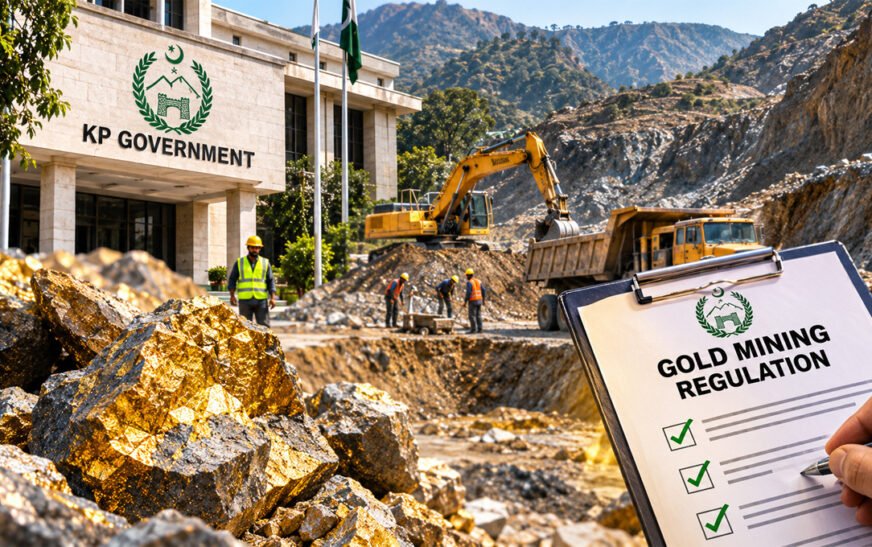
PESHAWAR: The Khyber Pakhtunkhwa (KP) government has established a high-level task force to regulate placer gold mining, prevent illegal extraction and ensure transparent management of the province’s gold resources.
According to an official notification issued by the Minerals Development Department on November 19, the task force will operate under the overall leadership and guidance of the Chief Secretary Khyber Pakhtunkhwa.
The initiative aims to review the existing legal, regulatory and administrative framework governing placer gold mining and introduce measures to improve oversight, protect authorised mining areas and safeguard government revenue.
The Secretary of the Home and Tribal Affairs Department has been appointed as the task force’s chairman, while the Additional Chief Secretary (General) will serve as co-chairman.
The Chief Coordinator of the Provincial Intelligence Fusion and Threat Assessment Centre (PIFTAC) and the Secretary of the Minerals Development Department will serve as vice-chairpersons.
Representatives from the provincial Minerals Development Department, Law Department, Environmental Protection Agency, Board of Revenue, Police, Frontier Corps North, Kohat Task Force, Military Intelligence, ISI and Intelligence Bureau have also been included.
New Law Proposed for Gold Mining
One of the major responsibilities assigned to the task force is to examine the existing legal framework, particularly the Khyber Pakhtunkhwa Mines and Minerals Act 2017, and prepare a separate law specifically dealing with placer gold mining.
The proposed legislation will cover exploration, allocation of mining rights, existing and future leases, extraction, production monitoring, transportation, storage and sale of gold.
It will also define institutional powers, environmental safeguards, community welfare provisions, government revenue collection and penalties for violations.
The task force has been directed to submit the draft law, along with its recommendations and a time-bound implementation plan, within 15 days of the notification’s issuance.
Transparent Auctions and Strict Monitoring
The task force will also develop recommendations for transparent and competitive auctions of future placer gold mining rights.
These proposals will include scientific assessments of gold reserves, valuation of mining blocks, reserve prices, lease periods, eligibility requirements, financial guarantees and operational plans.
It will also review proposals for dividing the remaining placer gold blocks into smaller areas for auction.
To improve monitoring, the government plans to introduce a comprehensive registration and verification system covering individuals, mining operators, workers, machinery, equipment and vehicles involved in gold extraction.
Digital records, geographical tagging, surveillance and a centralised monitoring dashboard will also be considered to track gold production and the movement of extracted material.
Crackdown on Illegal Mining and Gold Smuggling
Preventing unauthorised mining is another key responsibility of the task force.
It will recommend coordinated enforcement and security arrangements to protect legally authorised mining areas and prevent illegal extraction.
The proposed framework will also regulate the entire gold supply chain, including transportation, storage, processing, testing, valuation, purchasing and final sale.
Among the proposals is the establishment of a state-regulated Gold House or another suitable mechanism through which the government could regulate gold transactions. The option of the state acting as the first purchaser of extracted gold will also be examined.
The recommendations will focus on preventing gold smuggling, money laundering, illegal financing and the diversion of mining proceeds into unlawful activities.
Tougher Penalties and Environmental Protection
The task force will propose a stronger legal framework against illegal extraction, unauthorised possession and transportation of gold, unregistered machinery and violations of mining lease conditions.
It will also examine legal provisions for arrest, search, seizure, confiscation and forfeiture of machinery, vehicles, extracted minerals and proceeds linked to illegal mining, while ensuring appropriate legal safeguards.
Environmental protection has also been included in the task force’s terms of reference.
The proposed measures will address the protection of rivers, riverbeds, forests, water resources and agricultural land from the harmful effects of gold mining.
Environmental impact assessments, approved mining and restoration plans, water-quality monitoring and rehabilitation of affected sites will be among the recommended safeguards. The task force will also examine restrictions on hazardous substances, including mercury.
The Minerals Development Department will provide technical and administrative support to the task force, which may also establish specialised committees and seek assistance from technical experts and relevant government agencies.