
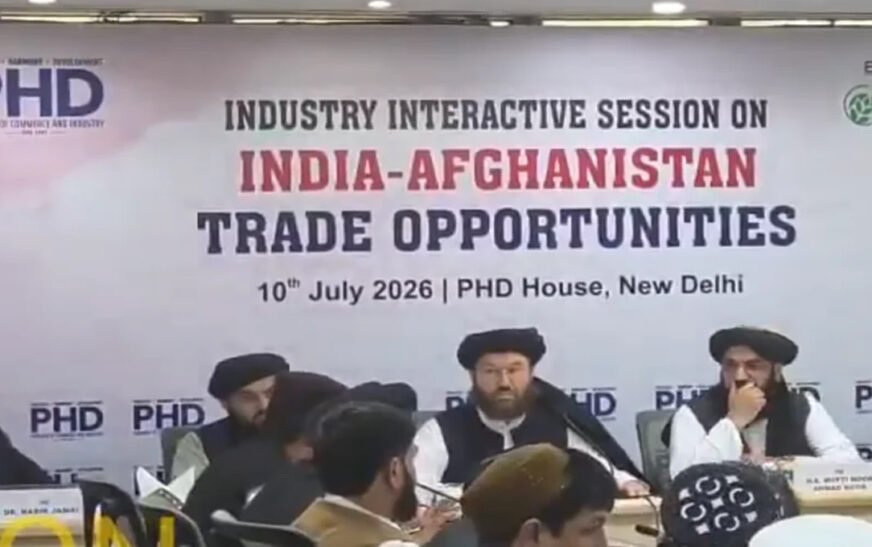
NEW DELHI: A high-profile visit by the Taliban’s acting Minister of Agriculture, Irrigation and Livestock, Mawlawi Attaullah Omari, to India has sparked a fierce geopolitical debate and social media backlash, spotlighting the shifting and highly pragmatic alliances in the region.
Speaking at a trade forum organized by the PHD Chamber of Commerce and Industry (PHDCCI) in New Delhi on Friday, Omari lauded the “centuries-old” ties between Kabul and New Delhi.
In Delhi, Afghanistan’s Agriculture Minister Mawlawi Ataullah Omari says Afghan, Indian “DNA is one”.
Thanking India for warm welcome, points, “feels like own people, not an Ajnabi place” pic.twitter.com/E8dA70pYst
— Sidhant Sibal (@sidhant) July 10, 2026
Seeking Indian technical expertise and investment to modernize Afghanistan’s struggling agricultural sector, the minister stated that he felt entirely at home in India. “From the day I landed in India, I received a warm welcome… So I feel like it is my own people, I don’t feel like I am in an unfamiliar place,” Omari said during the session. Echoing a sentiment raised during the event, he added, “our DNA is one.”
The comments and the warm reception afforded to him by Prime Minister Narendra Modi’s government have drawn heavy criticism from various political commentators and social media users, who accuse both sides of stark political opportunism.
For the Taliban, critics argue that the diplomatic overtures and the “shared DNA” rhetoric contradict the group’s strict ideological and puritanical foundations.
Analysts suggest that the cash-strapped administration, facing severe international isolation and deteriorating relations with neighbouring Pakistan, is willing to soften its ideological posture in exchange for vital economic lifelines, trade concessions, and market access for Afghan dry fruits and agricultural products.
Concurrently, the Indian government’s policy has faced scrutiny for what critics call a dual standard in its regional foreign policy.
While New Delhi has historically maintained a strong rhetorical stance against extremist groups on international forums, the administration has steadily deepened its practical engagement with the Taliban.
Omari is the fourth Taliban minister to visit India recently, highlighting a strategic calculus aimed at securing India’s geopolitical interests and maintaining a presence in Afghanistan, despite the ideological rift.
On social media, observers have characterized the engagement as a spectacle of mutual political necessity, where long-held security narratives and ideological doctrines have been sidelined in favour of raw strategic and economic pragmatism.