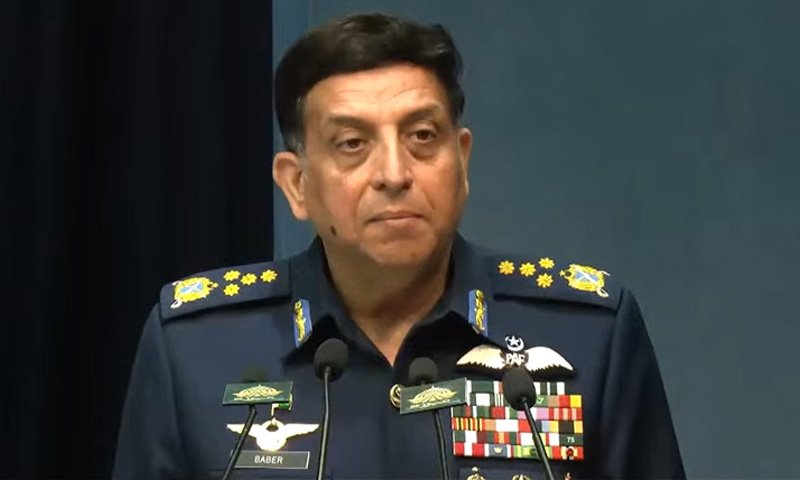

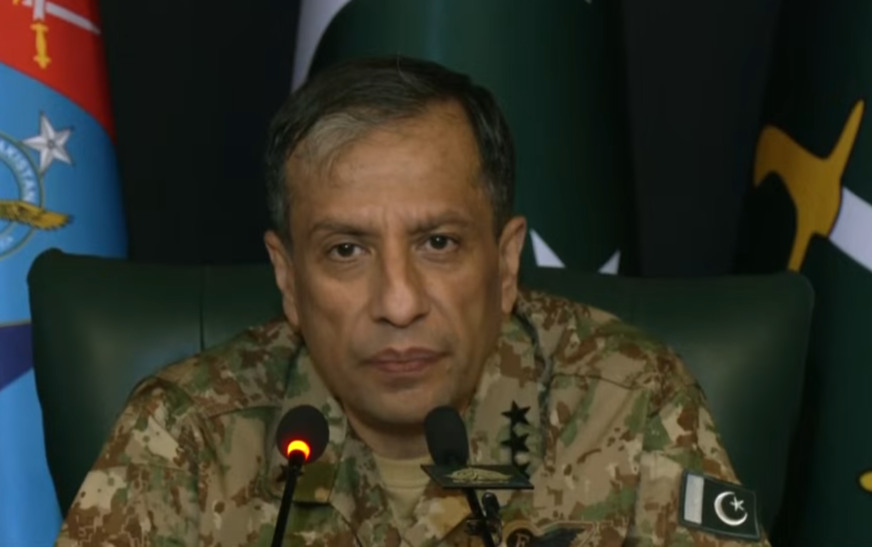
RAWALPINDI: Inter-Services Public Relations (ISPR) Director General Lt Gen Ahmed Sharif Chaudhry is currently addressing a press conference alongside the Deputy Chief of Naval Staff Operations, Rear Admiral Shafaat Ali, and the Deputy Chief of Air Staff (Projects), Air Vice Marshal Tariq Ghazi.
The press conference is being held as the nation commemorates the first anniversary of Marka-i-Haq. Welcoming those in attendance on this auspicious day, the DG ISPR congratulated the nation on the milestone, stating that the country’s armed forces successfully met national expectations by defeating a much larger adversary through effective multi-domain operations.
“Today, we are not going to dwell extensively on past events; instead, we will focus on the period from May 2025 to May 2026,” he stated, adding that the briefing would expand on the “strategic consequences” of the conflict.
He identified ten key strategic outcomes of Marka-i-Haq, noting first that the Indian narrative portraying Pakistan as a source of terrorism has been effectively buried. He emphasised that despite baseless attempts to link Pakistan to terrorism without evidence, and with a year passing since the Pahalgam incident, Pakistan’s formal inquiries remain unanswered. “Where is the evidence?” he challenged, asserting that the international community no longer buys such claims and views India’s accusations as lacking credibility.
The second consequence, according to the DG ISPR, was the consolidation of Pakistan’s role as the net security stabiliser in the region. He noted that Marka-i-Haq demonstrated Pakistan’s ability to control and dominate the escalation ladder, whereas India escalated the conflict based on a lie. He reaffirmed that Pakistan remains the foremost ambassador for peace in the region. Finally, he identified the third consequence as the increasing politicisation of the Indian military leadership alongside the militarisation of India’s political leadership.
In contrast, the DG ISPR said that Pakistan has presented the facts exactly as they occurred. He pointed out that Indian politicians have increasingly adopted the persona of “war mongers” through their rhetoric, warning that the dangerous intersection of politicising the military and militarising politics is a troubling trend.
Outlining the fourth strategic consequence, he noted that the international community now recognises India’s pattern of externalising internal crises—such as the repression of minorities and the situation in Kashmir, while utilising terrorism as an instrument of state policy. He attributed this behaviour to a “false sense of entitlement and a hubristic attitude,” arguing that instead of resolving domestic issues politically, India seeks to deflect by levelling baseless accusations against Pakistan. He further asserted that Kashmir is an internationally recognised dispute, and India lacks the authority to unilaterally enforce demographic changes there.
The DG ISPR reiterated that India not only sponsors terrorism within Pakistan but has even orchestrated incidents on its own soil to frame others. However, he noted that the global perception shifted after Marka-i-Haq, as the world became aware of these tactics.
He further identified the seventh and eighth consequences as the validation of Pakistan’s resilience against multifaceted threats and the firm re-establishment of deterrence. “Anyone suggesting there is room for war between two nuclear-armed neighbours is delusional,” he stated, reinforcing that Pakistan’s resolve should never be doubted. Finally, he concluded that the conflict solidified Pakistan’s status as a responsible, geopolitically significant middle power and, most importantly, forged an “unshakeable synergy” between the public, the government, and the military, a phenomenon he described as the “Bunyanum Marsoos effect.”
He said the Kashmir issue was an internationally recognised dispute with existing United Nations resolutions. According to him, despite demographic changes, legal measures and other Indian actions, the Kashmir dispute remained unresolved.
The DG ISPR said whenever India faced internal or external problems, it revived the terrorism narrative. He added that India often blamed others for various incidents and at times even used incidents within its own country for political purposes.
He said this was not a new strategy and that India had followed the same pattern for a long time.
Ahmed Sharif Chaudhry further said Pakistan gained practical experience of different dimensions of modern warfare during “Marka-e-Haq” and “Bunyan-un-Marsoos.”
He said modern warfare was no longer confined to traditional battlefields but had become multidimensional, extending across air, land, sea, cyber, information and even human minds.
According to him, the effects of such warfare were felt in cities, villages, streets and among ordinary civilians. He said modern conflict involved not only weapons but also information, narratives and psychological influence.
The DG ISPR said Pakistan faced all these challenges and demonstrated preparedness and an effective strategy on every front. He said Pakistan was prepared before the conflict, remained fully active during it and continued to stay ready for all threats.
Ahmed Sharif Chaudhry said Pakistan clearly conveyed during “Marka-e-Haq” that no compromise could be made on national defence and that the country possessed full capability to respond strongly to any aggression.
He added that Pakistan was prepared for every challenge and would respond effectively and immediately to any hostile action.
According to the DG ISPR, the vision of Pakistan’s founder Muhammad Ali Jinnah remains alive today that no conspiracy or aggression against Pakistan could succeed.
He said “Marka-e-Haq” delivered a message to the world that Pakistan was united and strong regarding its sovereignty, security and defence, and that this position was increasingly being recognised internationally.
At the press conference, DG ISPR also presented figures on counterterrorist efforts post-Marka-e-Haq. He said that India was given a “lesson of their life” and they fell back on their default option, which was terrorist proxies.
“We saw a surge in terrorist incidents post-Marka-i-Haq,” he said, showing the figures on the screen.
He said that in October, Pakistan struck terrorist support infrastructures in neighbouring Afghanistan. He said that the number of incidents subsequently went down.
He reiterated that terrorism in Pakistan was being carried out by India, and Afghanistan was being used as a base of operations.
“You saw who India called after they were taught a lesson in Marka-i-Haq. The Afghan Taliban regime’s so-called foreign minister,” he said.
During the press conference, the DG ISPR shared various clips from Indian media, remarking, “The Field Marshal and Pakistan seem to feature in their dreams day and night; they really need to grow up.” Following the video presentation, he noted that while they had provided an overview of the neighbour’s activities over the past year, he would now brief the media on Pakistan’s own progress during that same period.
He recalled his statement from May 11, 2025, emphasising that the military capability displayed during Marka-i-Haq represented only 10 per cent of the armed forces’ total power potential. Accompanied by footage showcasing the military’s advanced prowess, he asserted, “We are fully prepared; if anyone wishes to test our resolve, they are more than welcome.”
Whether war or peace, we know how to defend: Deputy Chief Naval Staff
Rear Admiral Ali addressed the press conference, characterising Marka-e-Haq as a “historic and memorable” conflict. He noted that before the hostilities, the enemy took great pride in its naval capabilities, which commanded a massive portion of its defence budget. Despite their “Made in India” initiatives and self-proclaimed status as a “blue water navy” and “net security provider,” the Rear Admiral pointed out a glaring discrepancy. He questioned why, despite such extensive resources and claims of maritime dominance, their naval forces were unable to muster the courage to challenge Pakistan during the conflict.
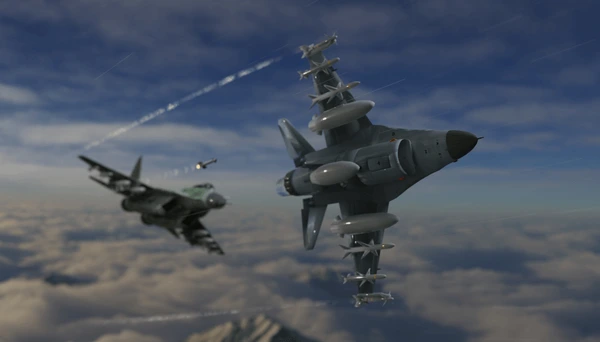
Our score is 8-0 Now, including 4 Rafale: Deputy Chief Air Staff
Air Vice Marshal Ghazi followed with his address, noting that once the national leadership established a strategic direction, comprehensive tri-service plans were synchronised under the field marshal’s guidance. He explained that the Pakistan Air Force (PAF) prioritised two immediate objectives: maintaining a robust defensive air posture and activating the highest state of alert. By integrating its multi-domain assets, the PAF prepared for any eventuality.
He further observed that while the Indian Air Force initially attempted aggressive deployments and tried to shield its critical systems from view, the PAF’s manoeuvres forced the adversary to reorganise its fleet. This recomposition inadvertently exposed the very targets Pakistan had been tracking. Discussing the military’s readiness, Air Vice Marshal Ghazi remarked that the enemy remained completely unaware of the depth of Pakistan’s preparations. He concluded by asserting that the PAF’s defensive strategy rendered the nation’s aerial sovereignty effectively impregnable.
Developing story: