
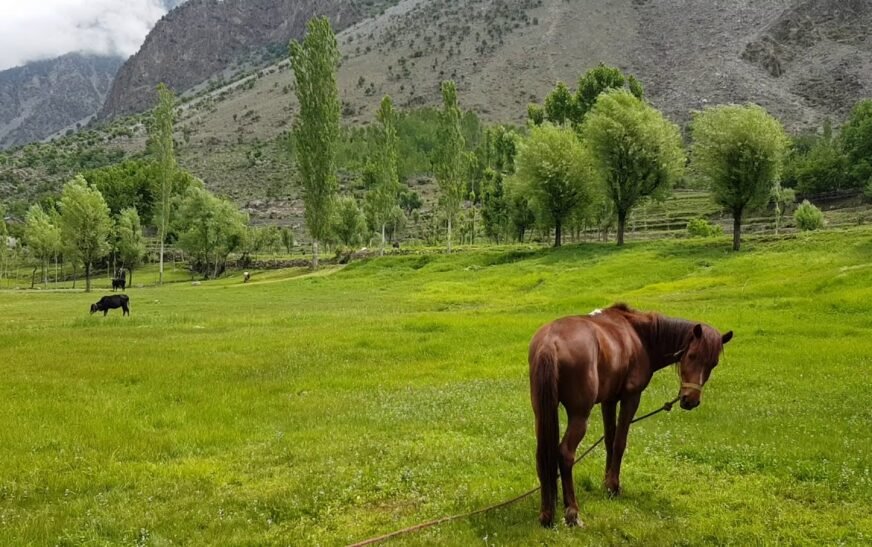
GILGIT, DIAMER: Tucked between the towering mountains of Diamer district, Darail Valley is known today for its natural beauty and a population of around 80,000. But beneath its green slopes and roaring rivers lies a history that stretches back thousands of years, when Darail was not just a remote valley, but a prosperous state, a centre of learning, trade, and Buddhist scholarship.
During the Buddhist era, Fogch in Darail stood as one of the region’s most important religious and academic centres. Monasteries dotted the valley where students from across Asia came to study. There were no modern roads then. Pilgrims and scholars crossed mountains, passes, and glaciers on foot, following branches of the ancient Silk Road through Central Asia and China to reach Darail.
“The idea that people travelled thousands of kilometers just for religious education tells you how important Darail’s monasteries were,” local historians note. Fogch was more than a seminary. According to oral traditions, it also housed an administrative and judicial centre — a court where disputes were settled. This points to Darail functioning as an organized, self-governed state with religious, administrative, commercial and social systems.
Darail’s geography made it a natural crossroad
Though surrounded by high peaks, it sat near ancient routes linking different regions. Caravans of traders, religious leaders, and students passed through, turning the valley into a meeting point of languages, cultures, and ideas. Markets in Gumari, Budhan, and Zarafa were famous in ancient times. They were not just places of buying and selling, but hubs where people from distant lands exchanged goods, stories, and knowledge. Agriculture, natural resources, and trade together made Darail economically and socially strong.
Local traditions still remember Darail as a wealthy state — rich because of fertile land, strategic location, and its role as a bridge between civilizations. The monasteries of Fogch were not only places of worship. They were universities of their time — centres for study, debate, and intellectual training.
Students would come, learn Buddhist philosophy and other sciences, and then return to spread that knowledge across Asia. Comparing that to today, when studying abroad is considered an achievement, the journey those ancient scholars undertook — across snowy passes and treacherous valleys — shows the extraordinary value Darail once held.
Empires fell, trade routes shifted, and many ancient centers faded. Yet Darail still holds the imprints of that glorious past. Rock carvings, ruins of monasteries, and local folklore all whisper of a time when the valley was alive with caravans, markets, and students.These are not just relics. They are proof that Darail was part of a larger Asian civilization.What Can We Learn From Darail Today?The history of Darail teaches that the real wealth of a land is not just gold or buildings, but knowledge, peace, trade, culture, and human connections.
“If people could travel thousands of miles for education in ancient Darail, why can’t we bring our heritage to the world today?” asks writer Inayatullah. “If Fogch was once a centre of learning, Darail can be made a centre of education, research, and tourism again. “He calls for proper research of Darail’s historical sites, preservation of ancient artifacts, awareness programs for locals, and opening the valley to national and international researchers.A Living Book of HistoryDarail is not just mountains, rivers, and meadows. It is a book with history written on every page.
The monasteries of Fogch, the old bazaars, the Silk Road trails, and the Buddhist centers all remind us of a time when Darail shone as a beacon of knowledge, commerce, and civilization.
Our responsibility today is to not let this heritage be forgotten. By documenting Darail’s history, educating the new generation, and telling the world, we can ensure that this beautiful valley of Diamer is remembered not just for its scenery, but for the vital role it once played as a bridge between ancient Asian civilizations.
Darail is not just a story of the past. If preserved, it can become a source of pride, research, tourism, and inspiration for generations to come.
Read also: Beauty Behind Bars: The tragic isolation of Buner’s snow-capped valleys