
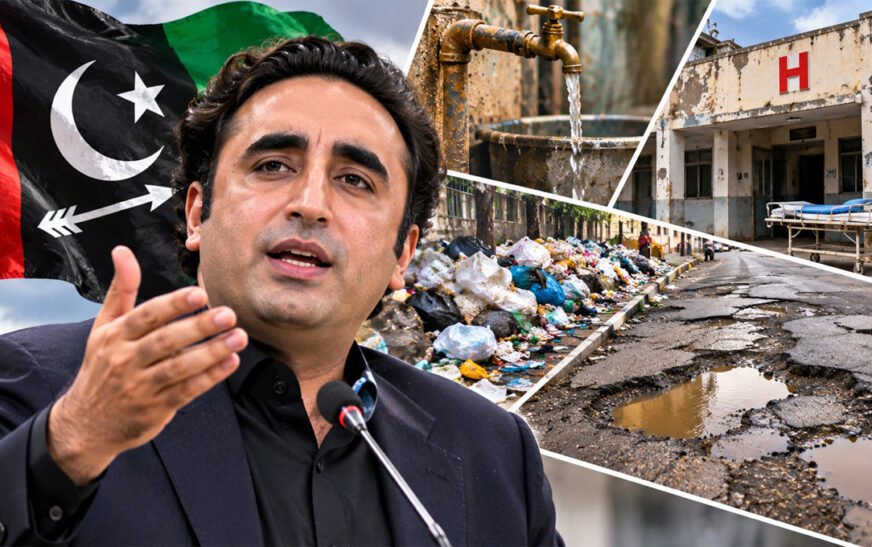
ISLAMABAD: Pakistan Peoples Party (PPP) Chairman Bilawal Bhutto Zardari has come under criticism following his recent press conference, with political commentators and sections of the public raising questions about the party’s political position, governance record and role in the country’s power structure.
Critics argue that the PPP’s presence in key positions of government, including the Presidency, provincial administrations in Sindh and Balochistan, several governor’s offices and the federal coalition, makes it necessary for the party to take greater responsibility for the country’s governance challenges.
They have questioned the party’s attempt to present itself as an opposition voice or an agent of political reform while remaining part of the governing structure at multiple levels.
The criticism has also renewed demands for accountability over the PPP’s nearly 18-year governance record in Sindh, particularly in education, healthcare, water supply, infrastructure and law and order.
Questions Over Political Accountability and Electoral Mandate
Political commentators have argued that responsibility for governance failures cannot be placed entirely on other political parties or federal institutions when the PPP itself holds influential positions across the political system.
They have also questioned what they describe as inconsistent standards regarding electoral legitimacy, arguing that political parties should be equally open to scrutiny over their electoral mandates and performance.
According to critics, no political party should consider its electoral position beyond public questioning or accountability.
Constitutional Amendments and Judicial Independence Under Scrutiny
The debate has also extended to the 26th and 27th Constitutional Amendments, which were previously presented by their supporters as significant political and legislative achievements.
Commentators have called for an open assessment of their implications for judicial independence, institutional autonomy and public confidence in the constitutional system.
They have also stressed that securing a parliamentary majority and achieving broader political consensus are two different matters, calling for greater clarity on when cross-party agreement should be considered essential for major constitutional decisions.
Freedom of the press has emerged as another important issue, with critics demanding concrete legislation and institutional safeguards to protect journalists and media organisations.
They have urged governing parties to clarify which restrictions they intend to remove and what practical reforms they are prepared to support.
Economic Concerns and Sindh’s Governance Record
The economic situation has also featured prominently in the criticism surrounding Bilawal Bhutto’s political statements.
Observers argue that warnings about economic deterioration offer little relief to struggling households unless they are accompanied by practical proposals addressing inflation, unemployment, agricultural costs and economic recovery.
Questions have also been raised about the Sindh government’s administrative performance, procurement procedures and financial management.
Critics say accountability should apply equally to provincial and federal governments, rather than being limited to institutions operating at the national level.
After nearly 18 years of PPP rule in Sindh, they are demanding measurable improvements in education, healthcare, clean water, infrastructure and public security.
They have further argued that financial disagreements between the federal and provincial governments should not become a justification for every administrative shortcoming.
Debate Over New Provinces and Khyber Pakhtunkhwa
The political discussion has also brought the question of new provinces and the situation in Khyber Pakhtunkhwa into focus.
Political commentators have pointed out that the creation of new provinces requires constitutional amendments and cannot be achieved through a referendum alone.
They have called for meaningful public consultation, adherence to constitutional procedures and protection of the rights of communities affected by any proposed changes to provincial boundaries.
Regarding Khyber Pakhtunkhwa, commentators have emphasised that political reconciliation must include credible commitments to counter terrorism and restore normal governance.
They have also called for a clear constitutional framework to address security concerns and prevent unnecessary federal-provincial confrontation.
Calls for a Clear Roadmap for Political Reforms
The broader criticism has centred on the need for specific evidence and practical solutions rather than general accusations against state institutions.
Commentators argue that any proposal for democratic reform or a political reset should include a clearly defined constitutional roadmap, supporting legislation and a realistic implementation timeline.
They have cautioned that changes designed merely to preserve political control or the existing power structure cannot be considered meaningful reforms.
Questions have also emerged about internal democracy within the PPP, particularly regarding its leadership structure and reliance on dynastic political traditions.
Critics argue that younger political leadership must demonstrate its willingness to introduce democratic reforms within its own party before advocating broader institutional and political changes.