
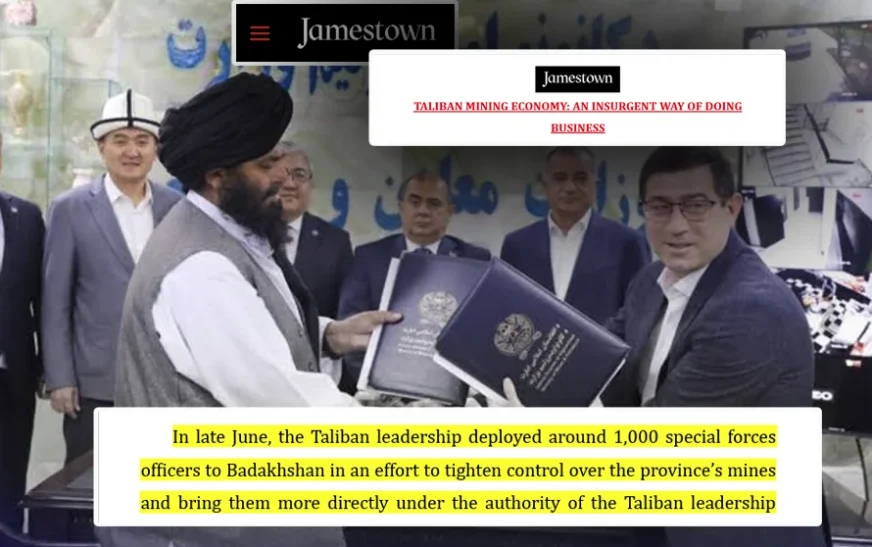
KABUL: A new report by the Jamestown Foundation has raised questions about how the Taliban government is managing Afghanistan’s large mineral resources. The report alleges that the mining sector is being used to earn money, increase political control and benefit people close to the Taliban.
The analysis by the US-based Jamestown Foundation says that the Taliban regime is exploiting Afghanistan’s vast mineral wealth through non-transparent mining contracts, taxes, royalties and licensing fees. The report says mining revenues are being used to strengthen elite networks and political control, while coercion, displacement and hazardous child labour remain concerns in mineral-rich areas.
Afghanistan is believed to have mineral resources worth more than $1 trillion. According to the US Geological Survey, more than 1,400 mineral deposits have been identified across the country’s 34 provinces. These resources could play an important role in Afghanistan’s economy.
The report says the Taliban government collects money from mining through taxes, royalties, licence fees and other payments. It also alleges that mining contracts and licences are benefiting networks linked to the Taliban.
According to the report, Nangarhar has become one of the provinces with the highest number of mining agreements under Taliban rule. Gold mining has also increased in Badakhshan and Takhar, where local figures allegedly linked to the Taliban have gained greater control over mining activities.
The report also highlights concerns about the impact of mining on local communities and the environment. It claims that children are doing dangerous mining work in some areas. Disputes over mineral-rich land have also reportedly led to violence and forced some people to leave their homes and land.
Some conflicts over mining sites have turned violent, increasing tensions and instability in affected areas. The James Town Foundation also mentioned Taliban claims that Afghanistan’s Ministry of Mines and Petroleum secured more than $7 billion in investment from China, Qatar, Türkiye, Iran and the United Kingdom by May 2024. However, the report said the full details of these agreements have not been made public.
Afghanistan was suspended from the Extractive Industries Transparency Initiative (EITI) in June 2024. The move raised further concerns about transparency and accountability in the country’s mining sector. The report also mentioned the appointment of Hedayatullah Badri as Afghanistan’s acting Minister of Mines and Petroleum in July 2024. Badri is on the UN sanctions list.
It said Taliban authorities also sent around 1,000 special forces personnel to Badakhshan in June to strengthen their control over mining areas. Afghanistan’s mineral wealth could help improve its economy and create new opportunities. However, the report says weak monitoring, a lack of transparency and concerns about accountability are making it difficult for ordinary Afghans to benefit fully from the country’s natural resources.
Read also: Afghan Taliban shell Pakistani civilian population in Bajaur; 3 martyred, including 2 children