

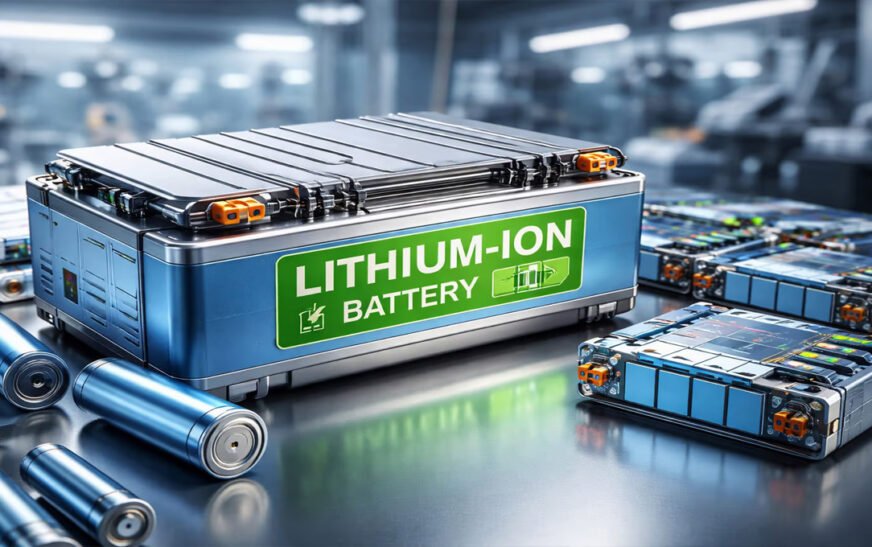
ISLAMABAD: Pakistan is set to take a significant step towards self-sufficiency in renewable energy solutions with the establishment of its first-ever lithium battery manufacturing plant in Karachi. This plant, which will focus on the production of batteries for electric bikes, vehicles, and solar energy systems, marks a major milestone for the country.
Pakistan Solar Association (PSA) has confirmed this information and has assured Engineering Development Board (EDB) of its cooperation. According to a report published by an English daily newspaper, it has been revealed that in a meeting between the two, CEO of Engineering Development Board, Hamad Mansoor informed that the policy regarding this matter has been forwarded to the Ministry of Industry & Production. This policy entails tax cuts on imported parts of lithium batteries with the intention of contacting the National Tariff Board and including this policy in the finance ministry budget of 2027-2026.
Hamad Mansoor has clearly stated the purpose behind proposing this policy. He believes that local production of batteries has become imperative for the future. He explained that because the future of energy will be all about batteries, producing lithium batteries locally has become necessary.
The plant will be set up by EV Technologies, an engineering firm. The company’s CEO, Hama Khattak, stated that the order for the lithium battery plant had been placed and production would begin in the coming 2-3 months.
The plant will be set up in the Korangi industrial area of Karachi with an initial capacity of 4 megawatts. The monthly output from the plant will be around 2,000 batteries.
Chinese scientists develop new battery system with 9,000 hours operation
Chinese scientists have developed a new battery system that allows lithium cells to be safely operated for thousands of hours. This innovation will provide better batteries for electric vehicles and power grids.
Lithium metal batteries have become central to future power systems due to their energy storage capabilities. However, the liquid electrolytes currently present in these cells pose several risks, including leakage and combustion. In addition, lithium metal diffuses into the battery, which puts its performance and safety at risk.
Various studies are suggesting that new types of electrolytes called deep eutectic gel electrolytes (DEGEs) could help solve these problems due to their high charge conduction capacity and inherent thermal stability. The latest, published in the Journal of the American Chemical Society, found that electrolytes made from a chemical called 2,2,2-trifluoro-N-methylacetamide hold the battery system together, preventing the formation of needle-like lithium branches. The study found that cells using this electrolyte system cycled stably for more than nine thousand hours.