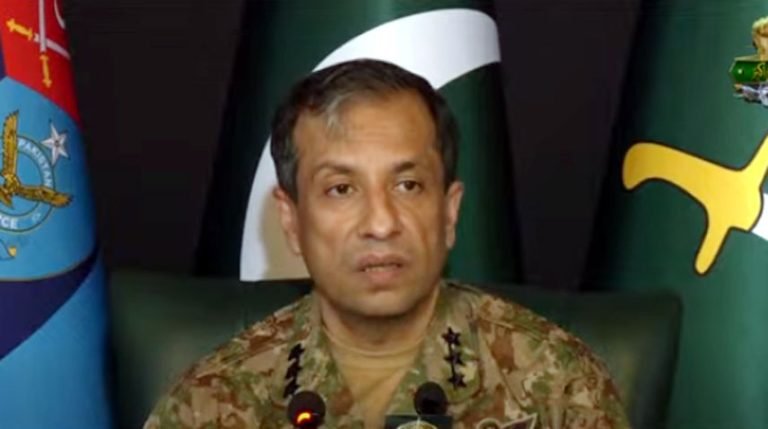

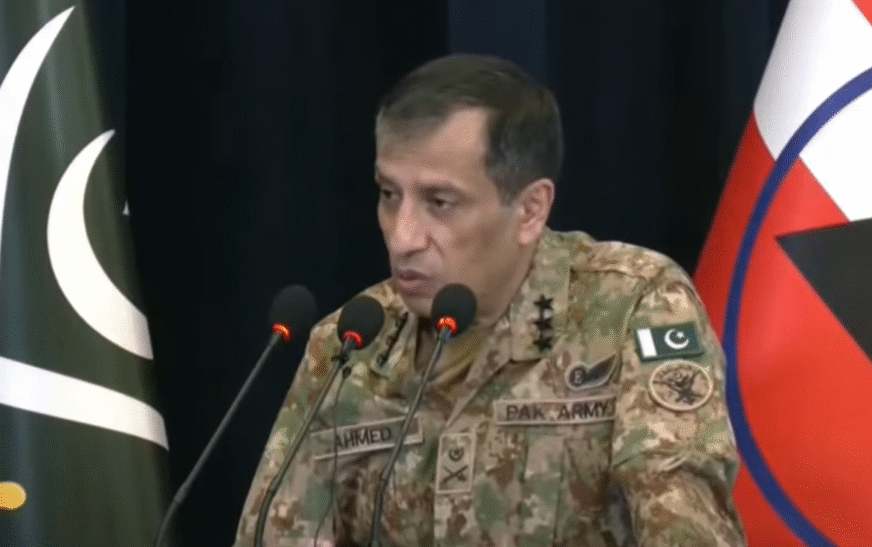
PESHAWAR: Inter-Services Public Relations (ISPR) Director General (DG) Lt General Ahmed Sharif Chaudhry said on Friday that 70 per cent of terror attacks occurred alone in Khyber Pakhtunkhwa province, and poor governance in the province has fueled terrorism in the province.
During a news conference in Peshawar, the DG ISPR stated that weak and deliberate governance had fueled terrorism in Khyber Pakhtunkhwa. Unfortunately, the National Action Plan (NAP) was not effectively implemented in the province.
“Appeasement of terrorists and their supporters is not a viable policy,” he stated, emphasising that the state and its institutions would not be swayed by “any political distortions.”
“The country and its citizens cannot be subjected to the whims of an individual who is primarily responsible for the resurgence of terrorism in Khyber Pakhtunkhwa.”
He expressed hope that the government would prioritise governance and the safety of the people it is obligated to safeguard. “We also hope that rather than seeking security from Afghanistan, you will focus on protecting this province and its residents.”
The Director General of the Inter-Services Public Relations (DG ISPR) started the press conference by honouring the “brave sons of the soil” of Khyber Pakhtunkhwa on behalf of Pakistan’s armed forces.
He explained that the press conference aimed to provide an overview of the security situation in Khyber Pakhtunkhwa.
For the last twenty years, Pakistan, especially KP, has been grappling with terrorism, he indicated.
Read also: DG ISPR highlights presence of terrorist safe havens in Afghanistan
Extremism fueled by deliberate weak governance in Khyber Pakhtunkhwa: DG ISPR
While while talking about the factors that caused uptick in terror events in KP, DG ISPR stated that the incomplete implementation of the National Action Plan, followed by the politicisation of the terrorism issue, India’s use of Afghanistan as a “launchpad for terrorism” against Pakistan, the supply of advanced weapons to militants in Afghanistan, and the presence of a “terrorism-criminal nexus” enjoying “full local and political support.”
Reflecting on the 2014 APS attack, he noted that all political parties, along with the provincial and federal governments, had formulated the NAP. “Every political party agreed that enforcing the NAP was essential to eradicating terrorism.”
However, he added, the previous government removed certain elements of the plan in 2021 despite progress in those areas and introduced a “revised” NAP. All political parties, provincial authorities, and the federal government then consented to the full enforcement of all 14 points of the updated plan, he said.
Referring to a graphic of the plan displayed on the screen, he mentioned the first point addressed kinetic operations.
“Is this being pursued or not? I have shown you the data for KP. In KP alone, aren’t law enforcement agencies carrying out more than 40 intelligence-driven operations?”
He maintained that empirical data proved work was underway on the first point of the NAP. He then questioned the efforts being made on the other 13 points.
“Are we united under a single narrative today? Don’t you hear calls for negotiations with these militants? Are we truly following the NAP?
“Is dialogue the solution to all issues? Think about it. If talks were the answer to every problem, then when India launched missile strikes on Pakistan on May 6 and 7 … why didn’t the nation say, let’s negotiate?”
If dialogue alone solved all problems, there would be no wars, he stressed.
Moving on to the fifth factor, he said the decision had been made to “disrupt the terror-criminal nexus” to eliminate terrorism. Additionally, it was resolved to “fortify the judiciary” concerning counter-terrorism cases.
Displaying another graphic, the DG ISPR detailed the cases in anti-terrorism courts in KP.
He revealed that no convictions had been made, with 34 cases still pending. “This is the judiciary that was meant to be strengthened. The political government at the time made that decision, not us.”
The DG ISPR further mentioned the decision to strengthen the KP police. Highlighting that the provincial police force currently comprises 3,200 personnel, he questioned: “Given the current terrorism situation, is this number adequate?”
He also pointed out that the repatriation of Afghan refugees from Pakistan was being “politicised.”
“False narratives were spread when these decisions were taken.”
He said that after the US withdrawal from Afghanistan in 2021, “they left behind weapons and ammunition now being used by militants. Those weapons were recovered from terrorists killed in operations in KP.”
Earlier, the DG ISPR said that last year, in 2024, 272 Pakistan Army and 140 police personnel were martyred, while 165 civilians were martyred in terrorist attacks.
He said that 516 people were martyred in Khyber Pakhtunkhwa this year, including the army, police and civilians. The number of foreigners killed this year was the highest in the last 10 years.