

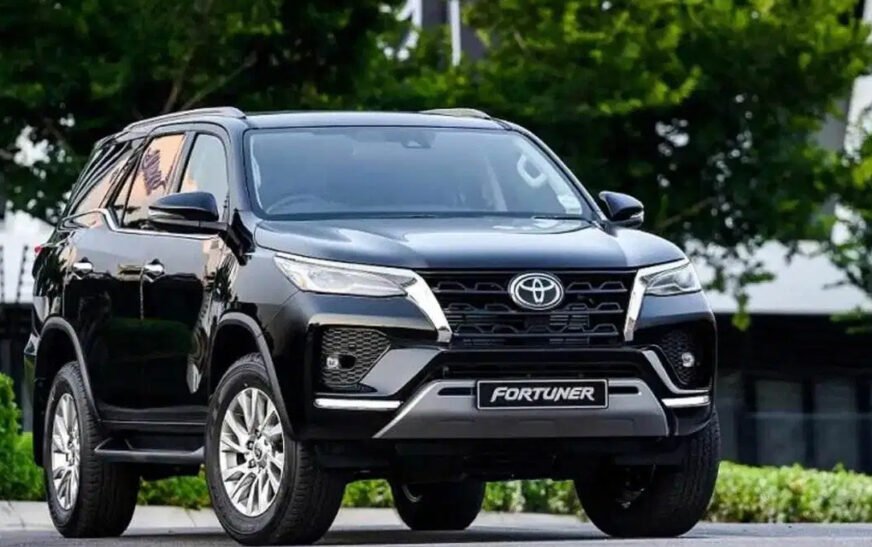
KARACHI: Toyota Pakistan has announced a special price reduction on its popular SUV, the Fortuner, as part of a limited-time promotional offer commemorating the company’s 35 years in the country.
As per the automaker, their promotional campaign provides purchasers with opportunities to procure vehicles at deep price cuts on a limited-period and a limited-stock basis only.
The offer includes:
The new price of Fortuner G is Rs 12,435,000 while the previous price was Rs 14,939,000.
Moreover, one can buy Fortuner V for Rs 14,935,000 which is more than Rs 2,500,000 slashes.
In fact, the reductions in both models are more than Rs 2.5 million each.
Toyota Pakistan celebrated the occasion of 35 years in Pakistan with a specially priced Fortuner, which they described as “a great vehicle”.
To add to that, the company has already reduced the price of Toyota Corolla Cross by more than Rs 600,000 just recently, thus, they are still taking the customer-friendly incentive route amid tough market conditions.
ALSO READ: Get Atlas Honda motorcycles in easy instalments with 0% mark-up
New Toyota Hilux 2026 Goes Electric, maintaining Diesel and Gas Engines
The new Hilux 2026 will go on sale in Europe this December, with production of the mild-hybrid diesel variant to follow next spring. Unsurprisingly, Toyota expects the latter to be the top seller on the continent.
The diesel remains the ideal all-rounder of the lot, and we reckon it will significantly undercut the purely electric model. The ninth-generation Hilux builds upon a proven formula, and Toyota appears to have made all the right updates. It has big shoes to fill, given that more than 21 million units have been sold since the original debuted in 1968. The truck is assembled in six countries and sold in over 180 markets. However, don’t expect to see it in the United States, where it would overlap with the Tacoma.
Over-the-air updates are supported, along with a broader suite of Toyota Safety Sense features such as Emergency Driving Stop System, Low-Speed Acceleration Suppression, and Proactive Driving Assist. The electric version adds a shift-by-wire drive selector, while all trims gain a wireless charging pad and new rear USB ports.
Toyota is overhauling its indestructible pickup for 2026, as the first time Toyota has engineered a fully electric Hilux. In fact, the BEV-badged model is spearheading the lineup’s rollout. That explains why all the press shots show the version without a combustion engine ahead of its market launch next month.
Considering it’s replacing a truck launched in 2015, it’s no surprise that the new Hilux looks substantially different. Toyota has beefed up the styling with a more angular design in keeping with the Tacoma. It too ditches the corporate logo in favour of a large wordmark, flanked by slender headlights for a more modern look.
The closed-off upper part of the front section denotes we’re looking at the EV version. Naturally, models with combustion engines will need additional cooling, necessitating a traditional grille. The charging port is mounted on the front fender, while combustion-powered versions are expected to retain the rear-mounted fuel cap.
Elsewhere, the wheel design is exclusive to the EV, and all variants feature a new rear deck step for easier access to the load bed. The side steps have also been redesigned to facilitate entry and exit. At the back, the tailgate adopts a slice of Americana with massive, debossed Toyota lettering. The truck’s name is neatly integrated into the door handle, just below the mandatory third brake light.
The Hilux’s interior was certainly showing its age, prompting Toyota to completely overhaul the cabin and bring it in line with its latest products. If the center console looks familiar, that’s because it’s inspired by the Land Cruiser’s. Much like the exterior, the cabin adopts an upright, angular design with geometric shapes to toughen up the overall look.
Toyota has long championed physical controls, and the new Hilux doesn’t disappoint. The dual 12.3-inch screens are complemented by a wide array of traditional buttons for the climate controls and 4×4 hardware. Most frequently used functions are just a button press away, minimizing the need to fumble through touchscreen submenus. It’s a functional, straightforward layout, which is exactly what you’d expect from a no-nonsense truck.
As for technical specifications, Toyota is focusing on the EV version for now. The dual-motor setup draws power from a 59.2-kWh lithium-ion battery pack, good for around 149 miles (240 kilometers) of WLTP range. The front motor produces 151 lb-ft (205 Nm) of torque, while the rear generates 198 lb-ft (269 Nm), resulting in a maximum payload capacity of 1,576 pounds (715 kilograms). For towing, the electric Hilux can pull up to 3,527 lbs (1,600 kg).
Still, Toyota knows the EV won’t suit everyone, which is why the 2.8-liter turbodiesel with mild-hybrid tech will continue in the new generation. It can carry up to 2,205 lbs (1,000 kg) and tow 7,716 lbs (3,500 kg), making it far better suited for heavy-duty work than the electric Hilux. In Eastern Europe, the lineup will also include non-electrified 2.8-liter diesel and 2.7-liter gasoline engines.
Looking ahead, Toyota’s diversification plan goes beyond battery power. Starting in 2028, a fuel cell version will join the range, because yes, Toyota still believes in hydrogen. The company is also collaborating with BMW to help the German automaker launch its first production fuel cell vehicle, the iX5 Hydrogen, in the same year.
Modernization extends to other areas as well. The new Hilux is the first of its kind to feature electric power steering (EPS), although it will be limited to Western European markets. Eastern Europe will retain the traditional hydraulic system. Additional new tech includes blind spot monitoring, a driver monitoring camera, and Safe Exit Assist.