
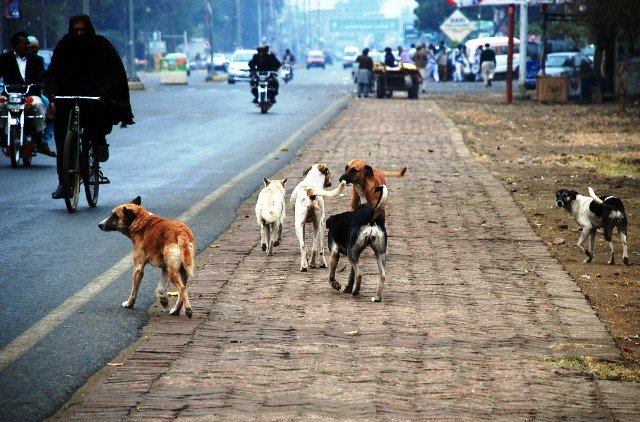
PESHAWAR (Salman Yousfzai): A rise in stray dog bite incidents on the campuses of Islamia College Peshawar and the University of Peshawar has sparked serious safety concerns among students, faculty members, employees and parents, particularly due to the risk posed to children.
The issue came into sharp focus after a minor student was bitten by a stray dog a few days ago, triggering alarm within the campus community.
Parents and staff members say the presence of stray dogs has become routine across residential areas, entry points and pedestrian pathways within the campuses, yet no effective measures have been taken by the administrations so far.
They allege that despite repeated concerns, the authorities have failed to implement adequate safety arrangements, improve campus surveillance or coordinate with district municipal bodies to control the situation.
These concerns emerge against the backdrop of a sharp rise in dog bite cases across Khyber Pakhtunkhwa.
According to figures released by the provincial health department, 87,364 dog bite cases were reported across 35 districts in 2025, compared to 60,223 cases in 2024 an increase of nearly 45 per cent.
The highest number of cases was reported from Mardan, where 13,328 people were bitten by stray dogs.
District Health Officer Mardan Dr Mohammad Shoaib said that most victims this year were provided anti-rabies vaccines, though complete data on vaccine procurement from some districts was still awaited.
He explained that since each district headquarters hospital procures vaccines from its own budget, compiling comprehensive province-wide data on vaccine availability remains a challenge.
In an effort to address the issue, Chief Secretary Khyber Pakhtunkhwa Shahab Ali Shah had, in November last year, directed the launch of a province-wide TNVR (Trap, Neuter, Vaccinate, Release) campaign.
Under the initiative, stray dogs will be humanely captured and shifted to designated centers for neutering, rabies vaccination and medical examination before being released back into their respective areas to maintain ecological balance.
The campaign is being jointly monitored by the district administration and the livestock department, with daily progress reports to be prepared.
The chief secretary has urged citizens to refrain from harming stray dogs, stressing that the government is pursuing a scientific, effective and humane solution to the problem.
Meanwhile, data from the city’s largest public-sector facility, Khyber Teaching Hospital, shows a steady rise in the use of anti-rabies vaccines. Hospital officials said 8,040 doses were administered between January 1 and October 24, 2025. In comparison, 7,006 doses were used in 2023, while 11,377 doses were administered in 2024.
Hospital authorities attributed the increased consumption to the growing number of dog bite cases and higher patient turnout, adding that steps were being taken to ensure uninterrupted vaccine supply.
Read also: Stray dogs bite injured six children in Shangla