

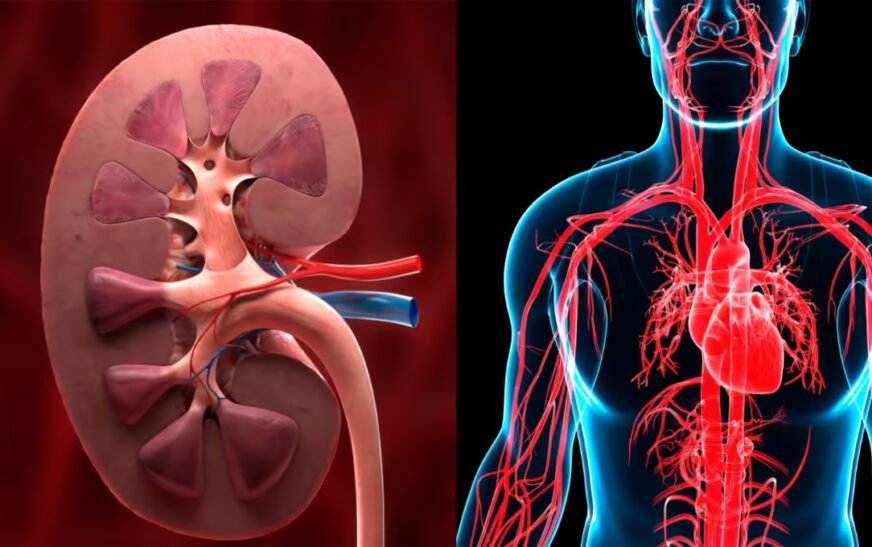
VIRGINIA: Researchers pinpointed the major factor for chronic kidney disease patients in having heart conditions with the highest death rate.
Chronic kidney disease (CKD) is frequently lethal not just due to the failure of the kidneys, but also because this condition quietly damages the heart, the scientists have come up with.
Scientists at the University of Virginia Health System have unravelled a vital biological mechanism that leads to a very high risk of death from cardiovascular complications in chronic kidney disease patients, and the research results were published in the journal Circulation.
For a long time, doctors have been noticing that the majority of patients with chronic kidney disease are prone to heart failure and other cardiovascular disorders. However, until now, the exact cause of this hazardous connection was not clear.
As per the research, unhealthy kidneys are discharging tiny particles into the bloodstream that are transporting poisons straight to the heart. These minute particles, called extracellular vesicles, usually serve as the communication channel between cells, moving proteins and other materials around the body.
For kidney disease patients, these particles pose a certain threat. The researchers discovered that the vesicles carry toxic substances that destroy heart tissue, thereby impeding the heart’s function and raising the risk of heart failure.
“The more damaged the kidneys are, the greater the impact on the heart,” the researchers said, establishing a long-suspected but previously unsupported link between the two organs.
This breakthrough was validated by laboratory studies on mice. When researchers controlled the release of these toxins, the ovine models demonstrated significant improvement in heart function.
Study finds human brain processes language like AI models
Meanwhile, the human brain’s spoken language comprehension has been found by a new study to be operating with a strikingly similar mechanism to that of state-of-the-art artificial intelligence (AI) models.
The research that appeared in the journal Nature Communications made use of the method known as electrocorticography (ECoG) to observe the brain activity of individuals who were listening to a short podcast. The scientists could then identify when and where the neurons responded during the processing of words.
The results indicated that the brain did not decipher the meaning of each word instantly. Rather, the comprehension of language went through several neural layers in a manner similar to how megamodels like GPT-2 and LLaMA 2 dissect the text.
The researchers elucidated that “the brain at first attends to single words and then little by little combines the context, the intonation, and the overall meaning.” This “processing hierarchy” is very similar to the way AI models comprehend language, although they are implemented very differently.
The research has come to a conclusion that AI-generated patterning may represent some attributes of the human cognitive process that are natural and consequently, the use of AI technologies might be extended from the simple text generation to other areas.
The researchers stated that the previously unexpected similarity between human neural processing and AI language models was, in fact, more pronounced than anticipated, thus shedding light on both the fields of neuroscience and AI development.