

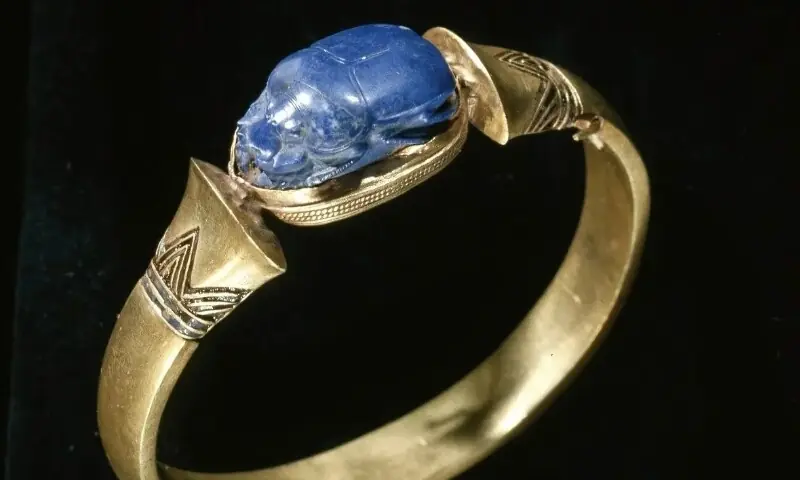
A nearly 3,000-year-old gold bracelet that belonged to Pharaoh has gone missing from the Egyptian Museum in Cairo.
According to Arab News, the gold bracelet, which has a lapis lazuli gem attached to it, was last seen in the museum’s restoration laboratory in Tahrir Square, the Ministry of Tourism and Antiquities said in a statement. It added that the matter has now been handed over to law enforcement agencies and the public prosecution. According to the statement, a photo of the bracelet has been sent to all airports, seaports and land border points to prevent any smuggling attempts. The museum’s director general clarified that some of the images shared online were not of the missing ring, but of another ring currently on display at the museum.
The valuable bracelet belonged to King Amenemope, who ruled during the Third Intermediate Period (1076-723 BC). According to the museum’s website, Amenemope is considered a lesser-known but intriguing king of the 21st Dynasty, who was initially buried in a small chamber tomb in the royal necropolis of Tanis. His remains were later reburied near those of the powerful pharaoh Psusennes I. His tomb was discovered in 1940.
Christos Serougiannis, an archaeologist from the University of Cambridge, said the disappearance of the ring was not surprising, given the huge global market for ancient antiquities. According to him, there are several possibilities, either the bracelet was stolen and smuggled and will sooner or later appear on an online platform, a dealer’s gallery or an auction house, possibly with fake documents. Another possibility is that the bracelet is melted down for gold, which is a less profitable but safer method. Another possibility is that it is hidden in a private collection, where the owner will know that it is stolen but will not take it out of his possession.
He added that sometimes such artefacts are also found back in the past, especially during the Arab Spring, objects taken from museums in Egypt were found a few days later in gardens or near museums. The ministry has said that all the remaining artefacts in the restoration laboratory will be catalogued and examined by an expert committee. The illegal trade in ancient Egyptian artefacts has long been a concern for the country. Last year, authorities arrested two men who were trying to steal hundreds of antiquities from the seabed of Abu Qir Bay near Alexandria and sell them. The men confessed to authorities that they intended to smuggle the items.
Read also: https://www.nytimes.com/2025/08/28/world/middleeast/egypt-alexandria-sunken-city.html