
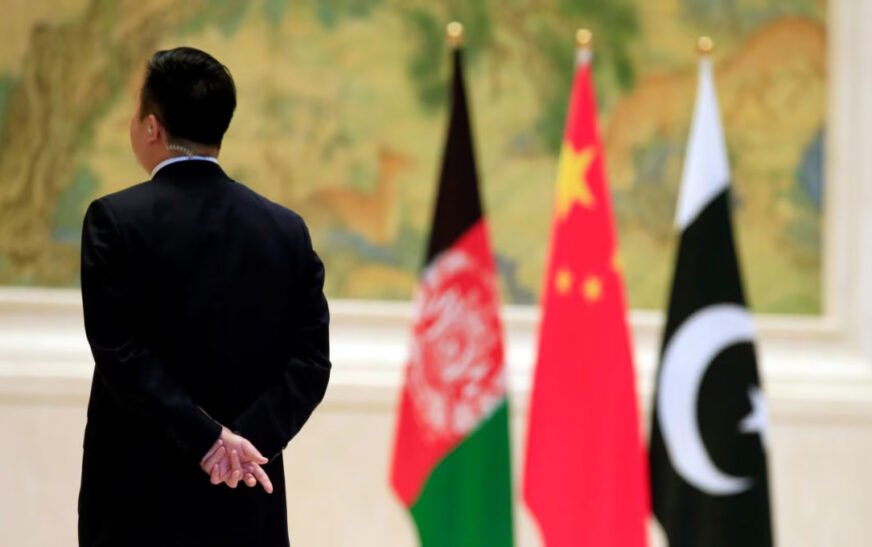
ISLAMABAD: A wave of fake news has been circulating on social media, claiming that Pakistan and the Afghan Taliban are set to hold talks in Urumqi, China, mediated and hosted by China. However, an official has dismissed these reports as false, clarifying that no such meeting is planned between the two parties.
The rumours, which have surfaced on various social media accounts, claim that a crucial round of discussions between Pakistan and the Afghan Taliban will take place in Urumqi, a city located in China’s Xinjiang region. The reports allege that China is stepping in as a mediator to facilitate these talks. Despite the widespread circulation of these claims, there has been no statement from the involved parties to verify the news.
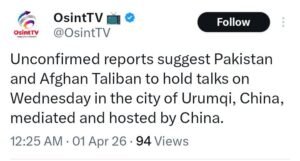
Diplomatic sources have emphasized that any such meetings would typically be announced through formal channels, rather than through unofficial or unverified reports.
Experts have cautioned the public to be wary of information circulating without credible sources, especially when it involves sensitive geopolitical matters. “Fake news can easily create confusion and mislead the public, especially in volatile political situations,” said a media analyst. “It is crucial to verify claims before believing or sharing them.”
Social media users have been advised to avoid spreading unconfirmed news, with officials urging people to rely on trusted news outlets for updates on international diplomatic events.
Operation Ghazab Lil Haq resumes against Afghan taliban after Eidul Fitr pause
Earlier on March 25, security sources confirmed the resumption of Operation Ghazab Lil Haq following a brief strategic pause observed in respect of Eid-ul-Fitr and diplomatic requests from brotherly Islamic nations. The temporary ceasefire concluded at midnight between March 23 and 24, marking a return to active kinetic operations.
The military campaign was initiated last month as a direct response to renewed hostilities along the Pakistan–Afghanistan border, triggered by unprovoked firing from Afghan Taliban forces. Pakistani troops had launched swift retaliatory strikes at the time, leading to the current sustained operation.
According to security officials, the campaign remains a “precise and targeted” military effort aimed at dismantling terrorist leadership and neutralising command infrastructures within areas controlled by the Afghan Taliban regime. The operation specifically targets logistics networks, facilitators, and abettors of terror proxies operating across the border.
Authorities asserted that the offensive will persist until all strategic objectives are met. Issuing a stern advisory, sources stated that the Afghan Taliban regime must “reassess its priorities,” urging Kabul to shift its focus from harbouring terror elements toward the welfare of the Afghan people and regional stability with Pakistan.