

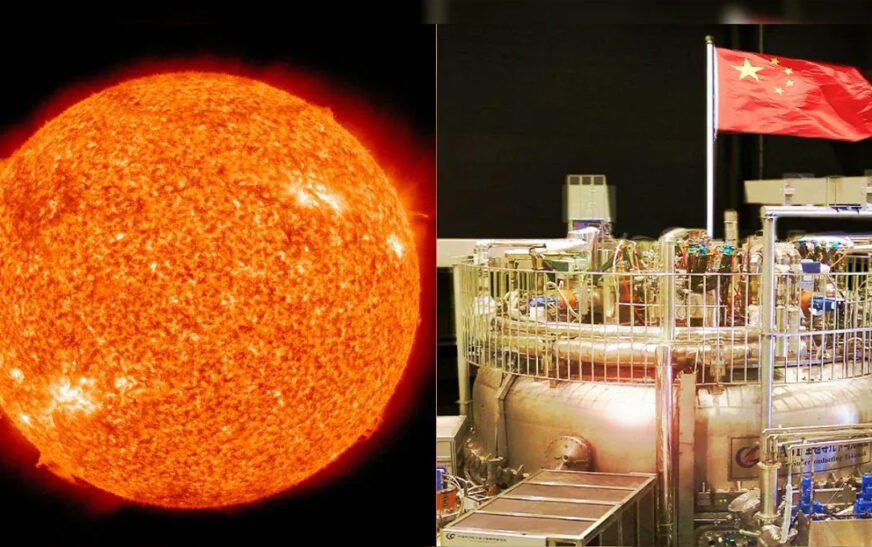
BEIJING: The scientists in China have crossed a major milestone in the field of nuclear fusion energy and this may very well lead to the next generation of energy sources. By winning plasma density that was thought impossible to be attained in the experimental nuclear reactor called “Artificial Sun” the team of the Chinese Academy of Sciences has made it.
Nuclear fusion is the process that can yield almost inexhaustible energy and at the same time, avoid harmful waste produced by conventional methods. It is a process that imitates the one occurring in the Sun, but large-scale replication has turned out to be an extraordinarily difficult task.
If this experiment is seen as a success, the world can get clean, nearly infinite energy quickly. The Chinese team’s accomplishment indicates a considerable development in the struggle against one of the main barriers in fusion energy research.
This X-ray has come after a series of successful experiments over the years. Just last year, the artificial sun reactor went for more than 1000 seconds of operation which was a new record until it was then unbeaten by France’s WEST machine.
Scientists are optimistic that this success will soon translate into the exponentiation power of clean and sustainable energy available with high revolutions. The implications can even be that the power generation on a global scale would not be as it is today.
Scientists claim first evidence of lightning on Mars
Meanwhile, Astronomers stated they have obtained proof of lightning activity on Mars, representing a revolutionary breakthrough in the study of the Martian atmosphere.
International news sources report that NASA’s Perseverance rover, which touched down on Mars in 2021 to investigate evidence of life has been studying the Jezero Crater area for the last four years.
The observed lightning event was identified via sound and electromagnetic data captured by the rover’s SuperCam device equipped with microphones and sophisticated sensors.
Researchers suggest that confirming these results might require deploying devices able to detect atmospheric electrical activity and cameras with greater sensitivity on upcoming Mars expeditions.
A French research group listened to the audio of the rover in Mars, which was more than two Martian years long (equal to 1,374 Earth days), for 28 hours.
Their results show that these are gaseous electrical discharges associated with dust storms and Martian wind events most of the times, which in turn implies that lightning on Mars may happen under certain atmospheric conditions.