

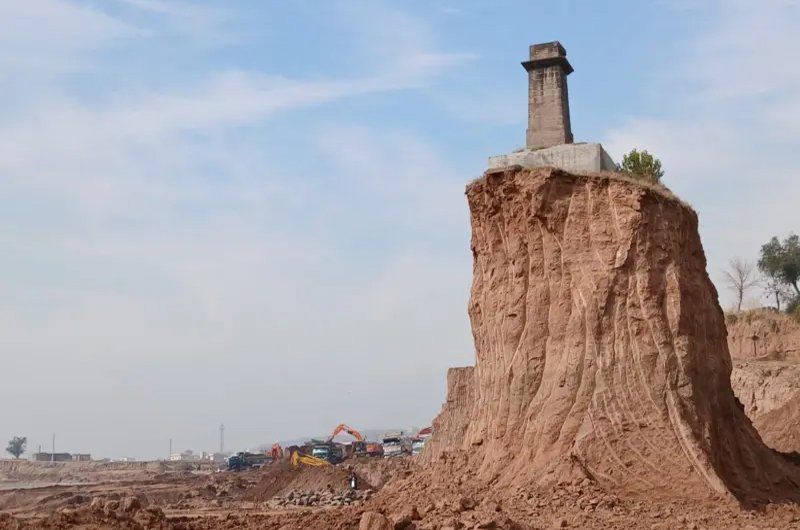
The Capital Development Authority (CDA) has issued a clarification on the relocation of the World War I monument, saying that this step is not to demolish the monument but for its preservation and better maintenance.
The monument was erected by the British Empire after 1914 to honour local soldiers who fought in the Great War. It stands as a symbol of recognition on Kuri Road near Rehara village, Barakahu union council but is now in danger of being knocked down due to development plans by CDA and a housing society.
The ground around the memorial has been cut and leveled by excavators and bulldozers of the developers. The memorial is left standing on a 35 to 40 feet high mound, inaccessible from all sides. The landmark has tilted and risks collapsing. According to the CDA, the said monument is being relocated to a more suitable, safe and accessible location so that it can be better preserved while maintaining its historical significance. The organization says that this step has actually been taken under the principles of conservation, not to demolish it.
The authority said that the monument was carefully disassembled under regular conservation protocols, in which the original bricks and other materials have been preserved so that it can be rebuilt in the same style later. According to the CDA, the condition of the monument had deteriorated over time, so its relocation will provide it with better protection and long-term maintenance.
The CDA further said that although the monument was not included in the official heritage list of the Department of Archaeology, the relevant department was consulted and all legal requirements were fulfilled. It was further informed that the formal consent of the legal heir of the monument was also obtained, in which the great-grandson of the deceased provided an affidavit and NOC.
According to the authority, the monument will be reinstalled under the supervision of the CDA at a safe and prominent roundabout near Rahara village near the Northern Bypass, where the public will have easy access to it and it will also be given due respect. The CDA also took the position that the relocation of historical structures due to development projects is a recognized practice worldwide, examples of which include the Cape Hatteras Lighthouse in the United States, Marble Arch in London and the overseas reconstruction of London Bridge.
The institution says that the monument pays tribute to Ghulam Ali’s bravery in the First World War and the award of the Military Cross, and its historical significance will remain. The CDA, while calling the claims of “pandemic” baseless, said that the media should verify the facts before broadcasting the news to avoid misleading information.
Read also: 400-year-old Mughal era Sheikh Imam-u-din mosque is one of the oldest symbols of national heritage