
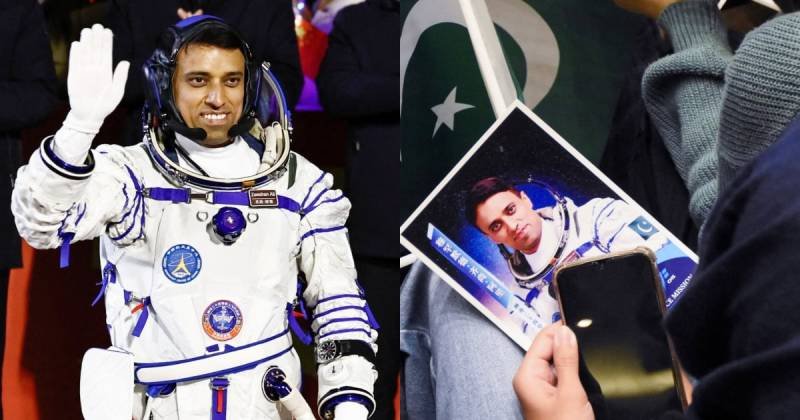
ISLAMABAD: Muhammad Zeeshan Ali has made history by becoming the first Pakistani astronaut to travel into Earth’s orbit and the first foreign astronaut to board China’s Tiangong space station, marking a major milestone in Pakistan’s space programme.
The 40-year-old Pakistani astronaut reached space on November 25, 2026, aboard China’s Shenzhou-24 spacecraft, which was launched from the Jiuquan Satellite Launch Centre in northwestern China.
Ali travelled alongside two Chinese astronauts, Tang Hongbo and Wu Yi, aboard a Long March-2F rocket. The spacecraft successfully entered its designated orbit around 10 minutes after launch and docked with the Tiangong space station approximately three hours and 38 minutes later.
The historic mission marked an important milestone in Pakistan-China space cooperation and opened new opportunities for Pakistani scientists to conduct research in the space environment.
But who is Muhammad Zeeshan Ali, how did he become Pakistan’s first astronaut, and what is he doing aboard China’s space station? Here is a closer look at his life, education, military career, astronaut training and historic space mission.
Who Is Muhammad Zeeshan Ali?
Muhammad Zeeshan Ali is a Pakistani Air Force officer and astronaut who made history by becoming the first Pakistani to travel into space.
Before his selection for the Chinese space mission, he served as a pilot in the Pakistan Air Force (PAF), gaining professional experience in aviation and flight instruction.
He was selected as a payload specialist for China’s Shenzhou-24 mission following a selection process jointly conducted under Pakistan-China space cooperation.
His responsibility aboard the Tiangong space station is to participate in scientific experiments developed through collaboration between Pakistani and Chinese researchers.
Early Life and Childhood Dreams
Muhammad Zeeshan Ali was born in 1986 in Sargodha, Punjab. He developed an interest in space exploration during his childhood and was fascinated by space missions, astronauts and developments in planetary exploration.
In an interview ahead of his historic mission, Ali recalled how astronauts such as Yuri Gagarin, Neil Armstrong and China’s Yang Liwei inspired his interest in space travel.
His curiosity about the universe also grew through mountain trips and observing the night sky. Watching stars, the Moon and planets encouraged him to learn more about space and the possibilities of human exploration beyond Earth.
His academic interests included aerosciences, information technology and war studies, providing a foundation for his later career in aviation and military service.
Pakistan Air Force Career
Before becoming an astronaut, Ali served as a pilot in the Pakistan Air Force, where he gained experience flying high-speed military aircraft.
He also worked as a flight instructor, helping train other pilots and developing the technical and professional skills required for aviation operations.
His experience in flying aircraft and teaching flight students later proved useful during the astronaut selection process.
Initially, Ali was involved in assisting with the selection process because of his aviation background. However, he was subsequently encouraged to participate as a candidate himself.
Following several rounds of assessments and examinations in Pakistan and China, he emerged as the successful candidate for the historic mission.
From Air Force Pilot to Astronaut
Ali’s journey towards becoming an astronaut began under Pakistan-China cooperation in human spaceflight. In February 2025, Pakistan’s Space and Upper Atmosphere Research Commission (SUPARCO) and the China Manned Space Agency (CMSA) signed an agreement for the selection and training of Pakistani astronaut candidates and their participation in a mission to China’s Tiangong space station.
Under the arrangement, two Pakistani candidates were selected for professional astronaut training in China, with one to be chosen for the actual spaceflight.
Muhammad Zeeshan Ali and Khurram Daud, both associated with the Pakistan Air Force, were selected for the programme. They travelled to Beijing on April 24, 2026, to begin their professional training at the Astronaut Centre of China.
The training programme covered spacecraft systems, space station operations, emergency procedures, scientific experiments and survival skills. The candidates also underwent physical conditioning and centrifuge exercises to prepare their bodies for the intense forces experienced during rocket launches.
Learning Mandarin was another important part of their preparation because China’s spacecraft systems, operational instructions and communication procedures use the Chinese language.
Ali trained alongside Chinese astronauts and developed the technical knowledge and communication skills required to work in a multinational crew. After completing the selection and training process, he was chosen as the payload specialist for Shenzhou-24, while Khurram Daud was designated as his backup astronaut.
How Did Zeeshan Ali Become Pakistan’s First Astronaut?
Pakistan’s participation in China’s human spaceflight programme was made possible through cooperation between SUPARCO and CMSA.
The February 2025 agreement provided a framework for selecting Pakistani astronaut candidates, providing professional training in China and sending one of them on a crewed mission to the Tiangong space station.
The selection process involved several stages of assessments to identify candidates capable of handling the physical, technical and psychological demands of spaceflight. Ali and Khurram Daud were selected for the programme and travelled to China in April 2026.
After months of training and evaluation, Ali was named a member of the Shenzhou-24 crew on November 24, 2026.
The announcement was made at a news conference at the Jiuquan Satellite Launch Centre, where Chinese officials introduced the three-member crew. Ali’s selection made him the first Pakistani astronaut to participate in an orbital space mission and the first foreign astronaut to visit China’s Tiangong space station.
What Is the Shenzhou-24 Space Mission?
China launched its Shenzhou-24 crewed spacecraft on November 25, 2026, from the Jiuquan Satellite Launch Centre in northwestern China. The spacecraft was carried into space by a Long March-2F rocket, lifting off at 8:18am Beijing time, equivalent to 5:18am Pakistan time.
The three-member crew consisted of:
- Tang Hongbo: Mission commander and Chinese astronaut.
- Wu Yi: Chinese flight engineer.
- Muhammad Zeeshan Ali: Pakistani payload specialist.
The spacecraft entered its designated orbit approximately 10 minutes after launch and successfully docked with the forward port of the Tiangong space station at 11:56am Beijing time.
The mission is part of China’s ongoing space station programme and also marks the first time a foreign astronaut has participated in a Chinese crewed spaceflight mission.
Ali is undertaking a short-term joint mission, during which he is expected to conduct scientific research and work alongside Chinese astronauts aboard the station.
Why Is Zeeshan Ali’s Space Mission Important for Pakistan?
Ali’s historic journey represents an important step in Pakistan’s efforts to develop its space exploration capabilities.
For the first time, a Pakistani astronaut has travelled into Earth’s orbit and participated directly in scientific activities aboard an international space station.
The mission also provides Pakistani universities and research institutions an opportunity to test their scientific ideas in microgravity conditions, which cannot be fully replicated in laboratories on Earth.
Pakistan-China cooperation in human spaceflight could also help Pakistani scientists and engineers gain experience in advanced space technologies, research and astronaut training.
The achievement has created new possibilities for Pakistan’s future participation in international space missions and further development of its scientific research programmes.
Prime Minister Shehbaz Sharif Speaks to Pakistan’s First Astronaut
On November 28, 2026, Prime Minister Shehbaz Sharif held a live conversation with Muhammad Zeeshan Ali aboard the Tiangong space station from SUPARCO headquarters in Islamabad.
The conversation was also attended by Chief of Defence Forces and Chief of Army Staff Field Marshal Syed Asim Munir, Deputy Prime Minister and Foreign Minister Ishaq Dar and Chinese Ambassador to Pakistan Jiang Zaidong.
The prime minister congratulated Ali on his historic achievement and praised his contribution to strengthening Pakistan-China cooperation in space exploration.
The interaction was an important moment for Pakistan, as the country witnessed its first astronaut communicating directly with its leadership from space.
When Will Muhammad Zeeshan Ali Return to Earth?
Unlike regular Chinese astronaut missions, which generally involve longer stays aboard the Tiangong space station, Ali’s participation is part of a short-duration joint spaceflight.
According to the mission schedule, he is expected to return to Earth aboard the Shenzhou-23 spacecraft on November 30, 2026, after completing the planned scientific activities.
His return will mark the completion of Pakistan’s first astronaut mission to China’s space station and an important milestone in the country’s growing cooperation with China in space research.
Read also: President Zardari extends congratulations to nation on space mission