

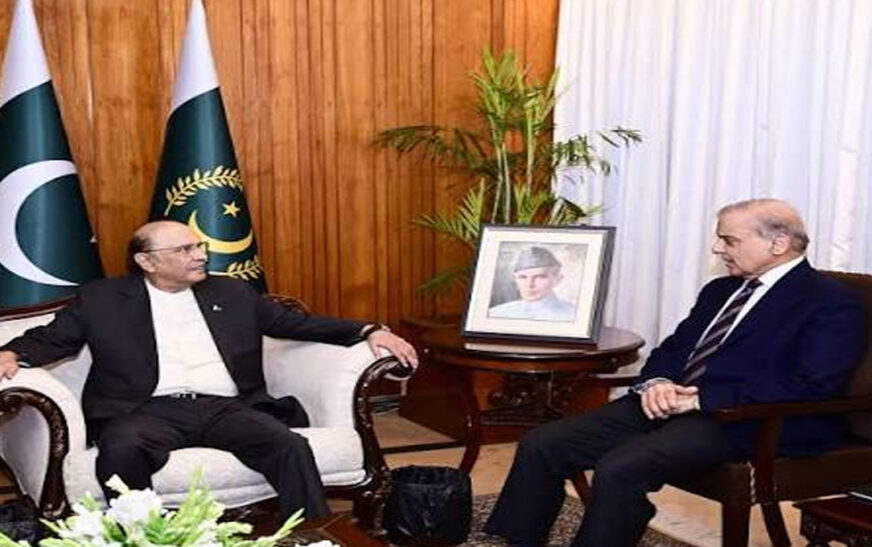
ISLAMABAD: A high-level consultative meeting chaired by President Asif Ali Zardari at the President’s House has reportedly agreed on imposing emergency in Khyber Pakhtunkhwa (KP) amid growing concerns over the province’s political and security situation.
The meeting reviewed the overall political and security situation in the province, with participants discussing proposed constitutional measures to address the prevailing challenges and maintain law and order.
Prime Minister Shehbaz Sharif, Deputy Prime Minister Ishaq Dar, Interior Minister Mohsin Naqvi and Federal Information Minister Attaullah Tarar attended the meeting, along with senior Pakistan Peoples Party (PPP) leaders Sherry Rehman and Naveed Qamar.
Federal Cabinet Meeting Called for Tomorrow
According to the information provided, an emergency meeting of the federal cabinet has been summoned for tomorrow to consider formal approval of the proposed emergency in Khyber Pakhtunkhwa.
The meeting at the Presidency reportedly reached an understanding on the proposed imposition of governor’s rule, while the federal cabinet is expected to consider the emergency measure as part of the government’s next steps.
The proposals come amid heightened political tensions between the federal government and the PTI-led provincial administration, alongside continuing concerns over security and counterterrorism efforts.
No Compromise on Peace and Security
Participants at the meeting reportedly expressed a firm resolve not to allow the situation to deteriorate under any circumstances.
The meeting emphasised that no individual or group would be permitted to undermine peace in the country or the province, reaffirming the government’s commitment to maintaining law and order.
Participants also reiterated that the state’s position against terrorism remained unequivocal and that there would be no compromise on peace and security.
The discussions highlighted the federal leadership’s stated priority of protecting citizens and preventing further deterioration in the province’s security situation.
National Assembly and Senate Sessions on October 13
According to the information provided, sessions of the National Assembly and Senate have been scheduled for October 13 to seek parliamentary endorsement of the proposed constitutional measures concerning Khyber Pakhtunkhwa.
The proceedings are expected to address the proposed imposition of governor’s rule and emergency measures, subject to the applicable constitutional requirements.
The developments could mark a significant turning point in the ongoing political confrontation between Islamabad and the provincial government.
Formal Approval and Constitutional Process Awaited
Although the meeting reportedly agreed on the proposed measures, the federal cabinet’s formal decision and the completion of the required constitutional procedures remain crucial steps.
Governor’s rule and the proclamation of an emergency are distinct constitutional mechanisms, each governed by specific legal conditions and procedures.
No official notification confirming that either measure has already taken effect was included in the information provided.
Further developments are expected following the federal cabinet meeting and the parliamentary proceedings scheduled for October 13.
Article 232: What Could an Emergency Mean?
Article 232 of Pakistan’s Constitution provides for an emergency proclamation in specified circumstances, including threats to the security of Pakistan or a part of its territory arising from war, external aggression or internal disturbance beyond a provincial government’s control.
If an emergency were lawfully proclaimed, the consequences for the PTI-led administration would depend on the terms of the proclamation and any subsequent constitutional orders.
Potential implications include:
Greater federal direction: The federal government could issue directions concerning the exercise of provincial executive authority under the constitutional framework.
Expanded legislative authority: Parliament could legislate on matters ordinarily within provincial jurisdiction, subject to the Constitution.
Possible administrative changes: Specified provincial functions could be assumed or exercised under constitutionally authorised arrangements.
Parliamentary scrutiny: The proclamation would be subject to the applicable requirements for presentation, approval and duration.
Article 232 also contains specific procedural requirements for an emergency based on internal disturbance beyond a provincial government’s control, including a resolution of the relevant provincial assembly. The precise constitutional route would depend on the grounds and circumstances cited for the proposed proclamation.
An emergency under Article 232 does not automatically remove the chief minister or dissolve the provincial assembly.







1 Comment
[…] In a separate advisory, the administration reiterated its instructions for residents to abide by the restrictions currently in force and avoid participating in any activity that could constitute a violation of the law. The authorities emphasized the importance of public cooperation in ensuring security and preventing disruptions to public order.Read also: Emergency in KP? Federal Cabinet Set to Make Crucial Decision […]