
France conducted its first nuclear test in the “first phase” at Reggane in the Sahara Desert of Algeria, which was then under French control. The test was codenamed Gerboise Bleue and took place on February 13, 1960, at 7:04 AM.
The location was the Saharan Military Experiments Centre near the Reggane desert, about 700 kilometers south of Colomb Béchar. France chose the Sahara for testing in 1957 because of its remote, deserted terrain. For the first series, the bomb was placed on top of a 336-foot tower. The explosion had a yield of 60 to 70 kilotons, making it about four times more powerful than the atomic bomb dropped on Hiroshima.
This test marked the start of France’s nuclear weapons program. It was followed by three more atmospheric tests at Reggane between 1960 and 1961. After completing tests at Reggane, France moved to In Ekker in the Hoggar Mountains of Algeria for underground testing from 1961 to 1966. Later, from 1966 onward, France shifted all nuclear testing to the Moruroa and Fangataufa Atolls in French Polynesia. Between 1960 and 1996, France carried out a total of 210 nuclear tests.
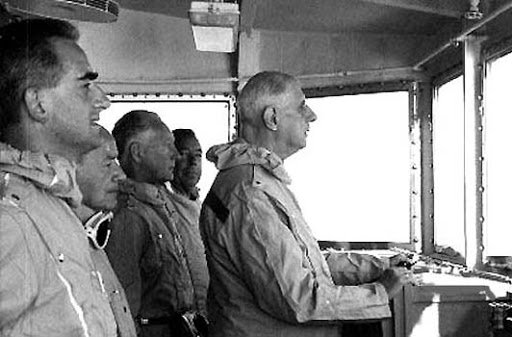
France began its nuclear weapons program in the 1950s under President Charles de Gaulle as part of its strategy to become an independent global power. Frustrated by being excluded from U.S.-UK nuclear cooperation, de Gaulle pushed for Force de frappe – France’s own nuclear deterrent – to ensure France “commanded its own destiny.”
Algeria was chosen as the first test site because it was a French territory at the time and its vast Sahara provided secrecy and safety. However, the tests drew international criticism, especially from African and Arab countries, due to radiation risks and colonial implications. After Algeria gained independence in 1962, France lost access to Saharan test sites. This forced France to move testing to the Pacific, where it conducted atmospheric and later underground tests at Moruroa and Fangataufa until it signed the Comprehensive Nuclear-Test-Ban Treaty in 1996.The 1960 Reggane test made France the fourth nuclear power in the world after the US, USSR, and UK.
Read also: France calls for immediate ceasefire, backs renewed negotiations after Islamabad pause